- November 8, 2026
- by Scarlett Wei
- SEO
- 0 Comments
Offshore SEO means hiring an SEO agency, specialist or remote team in another country to run your SEO work. Businesses use it to lower costs, extend working hours, and access skills they cannot hire locally. Done well, it gives you senior SEO capacity for less than a local team costs. Done badly, it delivers spam links, thin content and reports nobody can verify.
This guide explains what offshore SEO services include, what they cost (including salary benchmarks), how offshore compares with onshore options, and how to choose a provider. You also get a step-by-step hiring process, a risk checklist and a workflow for agencies that subcontract SEO.
Key takeaways
- Offshore SEO moves delivery abroad. You still own strategy, goals and account access.
- The main benefits are lower cost, longer work cycles, access to specialists and flexible capacity.
- Offshore does not mean low quality. Weak process, not geography, causes most failures.
- Judge providers on proof, process, reporting and link policy, not on price alone.
- Keep ownership of Search Console, GA4 and your CMS, and give providers user access only.
- Start with a paid pilot before you sign a long contract.
What Is Offshore SEO?
Offshore SEO is SEO work done by people in a different country from the business that pays for it. A US software company that hires an SEO team in Asia or Latin America is using offshore SEO. So is a UK agency that sends link building to a partner overseas.
People often mix up several terms. Here is how they differ:
| Term | What it means | Example |
|---|---|---|
| Offshore SEO | Work delivered from a distant country, often with a large time-zone gap | A US brand hires a team in South Asia |
| Nearshore SEO | Work delivered from a nearby country or similar time zone | A US brand hires a team in Latin America |
| Onshore SEO | Work delivered in your own country | A UK brand hires a London agency |
| Outsourced SEO | Any external provider, in any country | A freelancer or agency you do not employ |
| White label SEO | A provider does the work and the reseller sells it under its own brand | An agency resells a partner’s link building |
| SEO subcontracting | An agency passes part of a client project to another provider | An agency subcontracts guest posts |
Offshore SEO is one form of outsourcing. For the wider picture, see our guide to how to outsource SEO and the overview of outsourcing SEO services.
What Do Offshore SEO Services Include?
Offshore SEO services cover the same work as any SEO provider. The table shows what you can hand over and what to check.
| Service | What you get | What to check |
|---|---|---|
| Technical SEO audit and fixes | Crawl report, priority list, fix support | Sample audit and a clear priority order |
| Keyword research and content plan | Topic map tied to search intent | Real intent analysis, not keyword lists |
| On-page optimization | Titles, headings, internal links, schema | Before and after examples |
| Content writing | Articles, landing pages, refreshes | Native-level language and subject knowledge |
| Link building | Guest posts, link insertions, digital PR | Relevant real sites and a live link list |
| Local SEO | Profiles, citations, reviews support | Market-specific knowledge |
| Reporting and tracking | Rankings, traffic, leads, AI visibility | Access to live dashboards |
You do not need to outsource everything. Our list of SEO tasks you can outsource shows which tasks to hand over and which to keep.
How Mavrank helps: Mavrank delivers the two tasks that are hardest to run well from a distance, link building (guest posts and link insertions) and SEO content writing, with live link reports you can check.
What Are the Benefits of Using Offshore SEO Services?
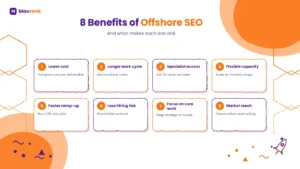
The main benefits of offshore SEO services are lower delivery cost, longer working hours, access to specialists, flexible capacity and less hiring risk. Each benefit is real only when you manage the relationship well, so the table also shows what makes it work.
| Benefit | Why it matters | What makes it real |
|---|---|---|
| Lower cost | Labor costs differ by country, so the same hours often cost less | Compare cost per deliverable, not hourly rates |
| Longer work cycle | Work continues while your team is offline | Agree on handover notes and a daily or weekly update |
| Access to specialists | You can hire niche skills such as SaaS link building or technical SEO | Ask for work samples in your niche |
| Flexible capacity | Scale content and links up or down by month | Use clear monthly scopes |
| Faster ramp-up | An established team starts without recruiting or training | Run a 30-day pilot |
| Less hiring risk | No salary, benefits or notice period if a hire fails | Keep a short initial contract |
| Focus on core work | Your team spends time on product, sales and customers | Keep strategy sign-off in-house |
| Market reach | Teams with language skills can serve other markets | Check native-level writing samples |
For the general pros and cons of outsourcing, read why outsource SEO. Keep in mind that big savings claims without a method are marketing, not data. Later in this guide you will learn how to calculate your own savings.
How Mavrank helps: Mavrank gives you an experienced off-page and content team without the cost of building one, with scoped monthly deliverables and reporting you can verify.
Offshore SEO Salary and Cost: What Does It Really Cost?
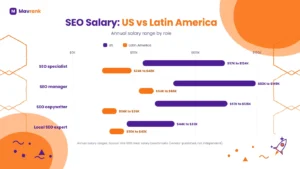
An offshore SEO specialist costs far less than a US-based one on paper, but the gap depends on the country, the role and how you hire. Recruiter benchmarks from Hire With Near put a US SEO specialist at about $57,000 to $124,000 a year and a Latin America-based specialist at about $24,000 to $48,000. Treat these as vendor-published benchmarks, not independent data.
| Role | US salary range | Latin America salary range |
|---|---|---|
| SEO specialist | $57,000 to $124,000 | $24,000 to $48,000 |
| SEO manager | $82,000 to $149,000 | $54,000 to $66,000 |
| SEO copywriter | $67,000 to $126,000 | $24,000 to $36,000 |
| Local SEO expert | $44,000 to $83,000 | $30,000 to $42,000 |
Salaries in other offshore regions, such as South Asia, Southeast Asia and Eastern Europe, vary widely by country and city. We found no independent benchmark we could verify, so request current local salary data and written quotes before you budget. Treat any percentage saving a provider publishes, without a method, as a claim.
What other options cost
| Option | Typical cost | Notes |
|---|---|---|
| Dedicated offshore hire (salary) | See the table above, plus recruiter, equipment and management time | You manage and train the person |
| Offshore freelancer | Agency guides quote about $50 to $100 an hour for freelancers in general | Offshore rates are often lower, so ask for quotes |
| Offshore agency retainer | Agency guides quote about $2,500 to $7,500 a month for typical agency retainers | Offshore agencies often quote less, so collect three written quotes |
| One-off project (audit, migration) | About $1,000 to $5,000 per deliverable in agency guides | Fixed scope and price |
How to calculate your own savings
Use this formula with real quotes:
Savings = Onshore total cost – (Offshore fee + tools + your management time + rework risk)
Example using the benchmark midpoints above: a US specialist costs about $90,500 a year and a Latin America-based specialist about $36,000. That is a gap of about $54,500 before benefits, tools and your management time. Subtract those costs from the gap to see your real saving.
How to keep offshore SEO affordable without cutting quality
If you want affordable SEO services offshore, control scope, not quality:
- Pay per deliverable, such as articles and links per month, instead of open hours.
- Start with a 30-day paid pilot before a long contract.
- Use a hybrid model. Keep strategy in-house and outsource links and content.
- Avoid the lowest bid. Very low prices usually mean templated content or risky links.
- Ask for a line-by-line scope so nothing is missing from the quote.
How Mavrank helps: Mavrank prices by deliverable, such as guest posts, link insertions and articles per month, so you know what each unit costs before you commit.
Offshore vs Onshore SEO: Which Option Fits You?
Choose offshore when cost, capacity and specialist skills matter most. Choose onshore when you need same-day calls, local market knowledge or tight compliance. Many businesses mix both: strategy stays close to home and execution goes offshore.
| Factor | Offshore agency or company | Onshore agency | Offshore freelancer or consultant | Dedicated remote hire |
|---|---|---|---|---|
| Cost | Lower to moderate | Highest | Lowest to moderate | Salary-based, plus management time |
| Control | Medium | Medium | High (you manage them) | Highest |
| Time to start | Days to two weeks | Days to two weeks | Days | Weeks (recruiting) |
| Time-zone overlap | Often limited, needs a plan | Full | Varies | Varies |
| Scalability | High | High | Low (one person) | Low to medium |
| Quality consistency | Process-driven | Process-driven | Depends on the person | Depends on the person |
| Best for | Ongoing links, content and reporting | Local, regulated or high-touch work | Single tasks and consulting | Long-term, in-house-style work |
Offshore SEO company or offshore SEO agency? The names overlap. An agency usually sells several marketing services. A specialist company often focuses on one area, such as link building or content. Pick the type that matches your biggest gap. You can also combine them, for example an agency for strategy and a specialist company for links.
When offshore is a strong fit
- You need steady monthly output, such as articles and links.
- You can write a clear brief and review work each week.
- Your work does not need daily live calls.
When to think twice
- Your industry has strict data or compliance rules.
- You need rapid, same-day changes on a complex site.
- You have no one to manage or approve the work.
How Mavrank helps: Mavrank works as a specialist offshore partner for off-page SEO and content, so you can keep strategy in-house and still ship links and articles every month.
How to Find Reliable Overseas SEO Service Providers
To find a reliable overseas SEO provider, build a shortlist from referrals and verifiable work, check each company’s proof and process, then compare two or three providers on the same written brief. Do not rely on search ads, rankings of directories or testimonials alone.
Where to look
- Referrals from founders and marketers in your industry.
- Case studies you can verify on live sites.
- LinkedIn profiles of team leads who publish about SEO.
- Review sites and directories, read with care and checked on several platforms.
- Freelance marketplaces for smaller or single tasks.
Ten checks before you sign
- Is it a real, registered business with a named team and address?
- Who will do the work, and does the provider use subcontractors?
- Can you see two case studies with verifiable results in your niche?
- How does the team find and approve link sources? What will it refuse to do?
- Can it show a sample report and a sample deliverable?
- Which tools does it use, and which reports will you see?
- How many working hours overlap with yours?
- How does it protect your data and accounts?
- Can you speak with two current clients?
- Will it run a small paid pilot first?
If you mainly need links, our guide to finding the right link building specialist goes deeper on vetting.
Key Factors to Evaluate When Hiring a Remote SEO Team
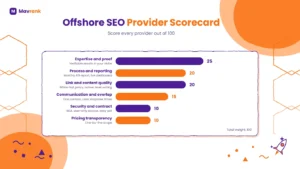
Score each provider out of 100 using weighted factors. A simple scorecard keeps price from dominating the decision.
| Factor | Weight | What good looks like |
|---|---|---|
| Expertise and proof | 25 | Verifiable results in your niche and market |
| Process and reporting | 20 | Written workflow, monthly KPI report, live dashboard |
| Link and content quality | 20 | White-hat policy, relevant real sites, native-level writing |
| Communication and overlap | 15 | One contact, clear response times, regular calls |
| Security and contract terms | 10 | NDA, user-only access, short term, easy exit |
| Pricing transparency | 10 | Line-by-line scope and cost per deliverable |
How to Choose the Best Offshore SEO Provider for Small Businesses
Small businesses should buy results in stages, not a big package. Follow this order:
- Fix the basics first. Start with a technical audit and quick fixes.
- Add content next. Publish pages that match what customers search for.
- Add links last. Build relevant links once your pages are ready to rank.
Also keep the contract simple. Choose a short initial term, a fixed monthly scope, a clear exit and a named contact. Ask for a provider that already works with businesses of your size, because large-client processes can be slow and expensive for a small budget.
Language and Market Fit (Including Référencement SEO Offshore)
If you target a market outside the provider’s home country, check language and search habits. In French-speaking markets, people search for “référencement SEO offshore” and similar terms, and the same logic applies to any language: keyword research must happen in the target language, not through translation. Ask for writing samples in that language, examples of local keyword research and proof that the team can handle hreflang and local search results. Google explains the setup in its guide to localized versions of pages.
If you need native-language content, our content creation service covers it.
How Mavrank helps: Mavrank’s checklist-driven onboarding, sample reports and native-language writing support make it easy to compare us against any other provider on the same scorecard.
How to Hire an Offshore SEO Specialist or Consultant
To hire an offshore SEO specialist, define the role, write a clear brief, screen candidates with a paid test, check references and start with a short contract. The same steps apply when you hire offshore SEO consultants for advice instead of daily work.
| Role | What they do | Hire when |
|---|---|---|
| Offshore SEO specialist | Does the hands-on work: audits, on-page edits, content briefs, link outreach | You have a plan and need execution |
| Offshore SEO consultant | Gives strategy, audits and guidance, and reviews the work of others | You need direction or a second opinion |
| Offshore SEO manager | Leads a small team, owns reporting and priorities | You run several sites or workstreams |
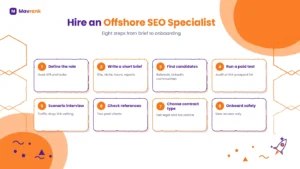
Step-by-step hiring process
- Define the role and the goal. Write the KPI the person will move, such as qualified organic leads, and list the tasks they will own.
- Write a short brief. Include your site, niche, tools, working hours and the reports you expect.
- Find candidates. Use referrals, LinkedIn, specialist communities and marketplaces. Invite people with niche proof instead of waiting for applications.
- Run a paid test. Pick a task that takes a few hours, such as a 10-page audit, a keyword plan for one topic or a list of 20 link prospects with reasons.
- Interview with scenario questions. Ask how the candidate would diagnose a traffic drop, vet a link source and report results to a non-expert.
- Check references. Speak with two past clients and ask about communication, honesty and results.
- Choose the contract type. A contractor agreement suits most remote SEO work. If you hire someone as an employee in another country, get legal and tax advice first, because employment rules differ by country.
- Onboard safely. Add the person as a user in Search Console, GA4 and your CMS. Never share your own passwords. Google explains how to add users in Search Console.
Interview questions that reveal quality
- Which SEO result are you most proud of, and what did you personally do?
- How do you decide whether a site is worth a link?
- What would you do in our first 30 days?
- How do you report to someone who is not an SEO expert?
- What do you refuse to do, even if a client asks?
If you also need a team member for links, read about guest posting and link placement before you brief them.
How Mavrank helps: If you would rather not hire and manage an individual, Mavrank gives you a specialist team for link building and content under one contract, with one point of contact.
Offshore SEO Risks and How to Manage Them
Offshore SEO carries real risks, but each one has a practical fix. Most problems come from a weak brief, poor oversight or an unchecked link policy, not from the provider’s country.
| Risk | What can go wrong | How to manage it |
|---|---|---|
| Risky links | Spam links, private blog networks and Google penalties | Require white-hat rules and a live list of every link. Review Google’s link spam policies together |
| Uneven content quality | Thin, translated or machine-written text | Ask for native-level samples, human editing and originality checks |
| Time-zone gaps | Slow answers and missed deadlines | Agree a daily overlap window, written handover notes and one weekly call |
| Weak communication | Vague updates and surprise delays | Name one contact, set response times and use a shared task board |
| Data and account security | Lost access or leaked data | Use user-only access, a password manager, an NDA and an offboarding checklist |
| Unclear ownership | Disputes about content or accounts | State in the contract that you own all content and accounts |
| Hidden subcontracting | Work passes to people you never vetted | Ask who does the work and require approval for any subcontractor |
| Lock-in | You cannot leave if results stall | Agree a short term and 30 days’ notice |
Contract points to include: scope and deliverables, term and exit, content and IP ownership, link policy, confidentiality, payment method and currency, reporting schedule and governing law. Have a lawyer review the contract if the work is large or crosses regulated industries.
A simple weekly workflow across time zones
- Monday: the provider shares the plan for the week.
- Daily: a short written update in your shared channel.
- Wednesday: a 30-minute call in the overlap window.
- Friday: completed deliverables and a link list.
- Monthly: a KPI report that ties work to leads, visibility and links.
How Mavrank helps: Mavrank shares every live link, keeps one point of contact and reports monthly, so distance never hides what was done.
Offshore SEO for Agencies: How to Subcontract and Resell Safely
Agencies use offshore SEO subcontracting to add delivery capacity, protect margins and offer services they do not staff in-house. The agency keeps the client relationship and the offshore partner does the work behind the scenes, often as a white label service.
A five-step subcontracting workflow
- Brief: you send a written brief with the client’s goal, niche, tone and rules.
- Production: the partner researches, writes and builds links to your scope.
- Quality check: you review each deliverable before it reaches the client.
- Unbranded report: the partner sends a clean report you can place under your own brand.
- Delivery and billing: you present results and bill the client at your own price.

Illustrative margin example (not a quote): if a partner charges $1,500 a month for a package and you resell it at $2,500, your gross margin is $1,000, or 40% of the sale price. Compare this with the cost of hiring and managing your own team before you decide.
What to demand from an offshore partner
- Unbranded reports and no direct contact with your clients.
- An NDA and a clause that stops the partner from poaching your clients.
- A written quality standard and a turnaround time for each deliverable.
- A link replacement policy if a placement is removed.
- Clear capacity limits, so you know how much work you can send each month.
- A named contact who replies within an agreed time.
For a deeper look at the model, read our guides to white label link building and how to choose the right white label SEO partner.
How Mavrank helps: Mavrank works with agencies as a white label partner for guest posts, link insertions and SEO content, with unbranded reporting and scoped monthly capacity.
FAQs About Offshore SEO
What is offshore SEO?
Offshore SEO means paying an agency, specialist or remote team in another country to do your SEO work, such as audits, content and link building. You keep ownership of strategy, goals and your accounts.
What are the benefits of using offshore SEO services?
The main benefits are lower delivery costs, longer working hours, access to specialists, flexible capacity and less hiring risk. You only gain them if you set clear scopes, review work and measure results.
Can offshore SEO hurt my rankings?
It can if the provider uses spam links, private blog networks or low-quality content. Choose a team with a written white-hat policy, a live link list and samples you can verify, and never give anyone sole ownership of your accounts.
How do I find reliable overseas SEO service providers?
Start with referrals and case studies you can verify. Check that the company is real, ask who does the work, review a sample report, speak with two clients and run a small paid pilot before you sign a long contract.
How do I choose the best offshore SEO provider for a small business?
Buy in stages: technical fixes first, then content, then links. Pick a provider that works with businesses your size, offers a fixed monthly scope, a short contract and a named contact, and reports on leads, not only traffic.
What are the key factors to evaluate when hiring a remote SEO team?
Score expertise and proof, process and reporting, link and content quality, communication and time-zone overlap, security and contract terms, and pricing transparency. Weight them so price never outranks quality.
How much does an offshore SEO specialist cost?
It depends on the country and role. Recruiter benchmarks put a Latin America-based SEO specialist at about $24,000 to $48,000 a year, against about $57,000 to $124,000 in the US. Get written quotes for other regions.
How long does offshore SEO take to show results?
Expect early signals, such as more impressions and new links, within weeks. Most providers see meaningful ranking and traffic gains in about 3 to 6 months. Competition, site history and budget change that timeline.
Ready to Add Offshore SEO Capacity?
Mavrank helps SaaS, tech and AI brands and the agencies that serve them grow organic traffic with relevant guest posts, link insertions and SEO content. Share your goals and we will suggest a scoped first project. Talk to Mavrank.