- July 26, 2026
- by Admin
- SEO
- 0 Comments
Handling every part of SEO in-house keyword strategy, technical fixes, content production, and link building— is a full-time job even for large marketing teams. That’s why so many businesses choose to outsource SEO to a specialist agency or freelancer instead of building an internal team from scratch. Done well, outsourcing gives you access to experienced specialists, frees up internal resources, and speeds up results. Done poorly — especially with a provider using outdated or manipulative tactics — it can get your site penalized under Google’s current spam and quality systems. This guide covers what SEO outsourcing looks like today, the real benefits and risks, and how to choose a partner. Whose methods hold up under Google’s 2026 ranking systems, including the ongoing Helpful Content system and core updates.
What is SEO outsourcing?
SEO outsourcing means hiring an external company, agency, or freelancer to handle some or all of your search engine optimization work instead of relying solely on in-house staff. That can include keyword research, on-page optimization, technical audits, content creation, and off-page work like link building and digital PR.
Businesses typically outsource because SEO requires specialized, constantly evolving knowledge — algorithm updates, changing user behavior, and shifting content standards mean a strategy that worked two years ago may no longer work today. An external partner who works across multiple clients and industries usually has more exposure to what’s currently effective and what’s likely to get a site penalized.
Outsourced SEO can be structured as a one-off project (like a technical audit) or an ongoing retainer that covers strategy, content, and reporting. Pricing generally scales with scope, deliverables, and the provider’s level of expertise.
A common starting point for many businesses is a comprehensive SEO audit. This involves a deep dive into your website’s technical health, on-page optimization, and overall site structure to identify both issues and opportunities for improvement. An effective audit sets the foundation for a successful SEO strategy—pinpointing exactly where your site stands and what should be prioritized, whether you’re planning ongoing work or a targeted project.
How has the SEO landscape changed with AI Overviews and Answer Engine Optimization (AEO)?
The search landscape is increasingly shaped by AI-powered features and the evolution of how answers are presented to users. With Google’s AI Overviews now appearing atop a significant portion of U.S. search queries, traditional organic listings are being pushed further down the page—reducing their share of visibility and clicks. Meanwhile, platforms like ChatGPT, Perplexity, and Gemini drive a new focus on Answer Engine Optimization, or AEO, which centers on structuring content to be accurately cited by AI-driven systems.
The result? Ranking for classic blue links is only part of the equation. To stay competitive, SEO requires not just technical and on-page optimization, but also a sophisticated content strategy designed for both human readers and AI answer engines. Instead of only targeting keywords, businesses need to consider how their information appears in AI-generated responses, highlighted snippets, and voice search.
Staying ahead in this environment demands expertise across search algorithms, AI developments, and content structuring best practices. For most organizations, adapting to these shifts internally—on top of their existing responsibilities—is an uphill battle. That’s why having external SEO support with proven experience in both traditional and emerging tactics is more valuable than ever.
What is white label SEO—and why do agencies use it?
White label SEO refers to a service model where an outside provider handles SEO work on behalf of an agency, but all deliverables are branded and presented as if the agency produced them directly. This approach is especially popular among digital marketing agencies and web design firms that want to offer specialized SEO without hiring an in-house team or building out new areas of expertise.
The biggest advantage for agencies? Flexibility and scalability. Instead of recruiting, training, and retaining dedicated SEO staff, agencies can quickly extend their service offerings, take on new clients, or manage fluctuating workloads—without adding to overhead. For example, if a client wants a technical audit or ongoing link building, the agency can tap into white-label SEO partners like The Hoth or SEMrush Agency Partners, providing expert results under their own brand umbrella.
Ultimately, white label SEO lets agencies focus on client relationships and strategy, while experts handle the detailed execution behind the scenes. This not only preserves agency bandwidth but also lets them confidently promise results using up-to-date, industry-standard practices.
Types of outsourced SEO services
Outsourcing SEO services is typically employed depending on the company’s needs and financial capabilities. This means that one can outsource a certain portion of the service or fully outsource and get services from an SEO company.
Here are the main SEO services you can outsource:
On-page SEO:
On-page SEO is the process of optimizing every website’s page to achieve the top rank on search engine results. This involves techniques such as: keyword selection, title tag optimization, meta description optimization, header tag optimization, and internal link optimization. It also presupposes that the content of the Website is unique and valuable. The targeted keywords are used without attempts at placing them into the text. Various elements are optimized on the page level through this. On-page SEO enhances the search engine’s ability to understand the information presented on the pages. It also helps search engines retrieve such pages when people enter specific keywords.
Off-page SEO:
Off-page SEO is a process of collecting backlinks from other websites to improve the website’s ranking. This mainly consists of link building, which involves obtaining external links pointing to your site from other equally authoritative websites. Some of the off-page SEO activities include Blogging, social media marketing, and outreach. Such actions contribute to establishing your site’s credibility and, subsequently, getting better search engine ranking results.
Technical SEO:
Technical SEO targets the structural and other features of the website, which do not affect users directly but are imperative for search engines. This includes elements such as site speed, mobile responsiveness, creating an XML sitemap, and site organization. In addition, technical SEO entails a process of correcting flaws, for instance, broken links and duplicate content, and index checks. These optimizations assist search engines in crawling and indexing your site.
Local SEO:
Local search engine optimization is a procedure that enhances the website’s exposure to achieve a greater ranking in local searches. This is even more a necessity where the business is located in a specific geographical location; it is bound to operate in an environment that is characterized by a particular culture. Some of the local SEO techniques are as follows: improving your Google My Business, getting local citations, and getting positive reviews. It also comprises the creation of local content and the optimization of NAP (Name, Address, Phone number) data.
For businesses targeting local markets, outsourcing local SEO can significantly boost your online visibility. An experienced SEO agency specializing in local SEO can optimize your site for local searches, helping you attract more customers from your target area. This is particularly crucial for small businesses that depend on local clientele and want to stand out within their community. By leveraging these local SEO strategies, your business becomes more discoverable to nearby customers actively searching for your services.
Content SEO:
Content SEO aims at writing content that enhances the ranking of your site in the search engine or on a page. This involves the ability to do keyword research and write good blog posts, articles, and other forms of content. Content SEO also includes having a good content plan that seeks to capture the business objectives. At the same time, it should offer quality content to the viewers.
The Power of Integrating SEO and PPC
When it comes to building a robust online marketing presence, integrating SEO and PPC can create a dynamic synergy that delivers results greater than either channel can achieve alone. Here’s how combining these strategies supports a comprehensive approach:
Amplified Visibility
Organic SEO helps your website climb search engine rankings through optimized content and technical improvements, while PPC ads immediately place your site at the top of relevant search results. The combination means your brand can dominate both paid and organic listings, increasing the likelihood of user engagement.
Shared Data for Smarter Decisions
By analyzing keyword performance and user behavior data from both SEO and PPC campaigns, you gain deeper insights into what resonates with your audience. For instance, high-converting keywords in PPC can inform your content strategy, and strong organic performers may signal opportunities to maximize paid campaigns.
Broader Traffic and Targeting
Integrating both channels lets you reach a wider audience. While SEO delivers sustainable, long-term organic growth, PPC allows you to target highly specific demographics or test new markets quickly. Running both simultaneously means you’re not putting all your eggs in one basket.
Coherent Brand Messaging
Unified strategies allow for consistent messaging across every touchpoint—ads and organic results alike. This coherence reinforces brand trust and keeps your value proposition clear, no matter where your users encounter you on Google, Bing, or elsewhere.
By merging the strengths of SEO and PPC, businesses can maximize exposure, fine-tune campaigns with cross-channel learning, and drive both immediate and long-term growth.
Benefits of outsourcing SEO
Here are the main advantages of outsourcing SEO services:
Expertise:
Hiring a third party to do SEO for you comes in handy because the specialists are aware of the latest trends and ad strategies. They possess the necessary experience and expertise to develop a successful campaign that has the potential to boost the ranking of your website in the search engines, hence the traffic flow.
This always proves to be a challenge, even for strong in-house SEO teams that are typically responsible for these changes. Unfortunately, for companies of a fairly small size, it is almost impossible to hire someone simply to work on SEO.
Cost-effective:
It is costly to have an in-house SEO team. This way, outsourcing SEO services is more affordable than having in-house professional services since it eliminates some overhead expenses for hiring full-time employees.
It saves costs because you only hire the services of the outside service provider when you need them, without necessarily having to cater for the other incidental expenses
Scalability:
Outsourcing also enables one to increase or reduce the amount of SEO services he or she is obtaining from an SEO service provider at any given time, depending on the amount of money one is willing to spend towards SEO services. This allows you to revise your approaches when your firm expands over time or meets new challenges in the market.
Potential drawbacks of outsourcing SEO
However, there are certain risks and challenges involved in outsourcing SEO, as explained below.
Lack of control:
This is one of the major disadvantages of outsourcing SEO services. This distorts the level of control a company has over the Strategies and tactics used. This results in an undesirable scenario where most of the factors of production are either neutral to the business or have negative impacts on the set goals and objectives. This means that you would not have the opportunity to direct the day-to-day operations, hence frustration setting in about whether the agency’s approach is in congruence with your expectations. I have realized that this is a common problem. One can avoid this by establishing mechanisms that enable good communication and setting highly detailed standards right from the first time communicating with the client.
Communication barrier:
Reporting to an external agency escalates communication problems, particularly if the agency is in another time zone. They can lead to such negative consequences as time delays, lack of mutual understanding, and different goals. These are communication barriers that can be overcome by scheduling daily check-ins. You should also ensure that everyone uses the collaborative tools, but it’s going to take some work and planning.
Quality concern:
Choosing the wrong agency will always be a possibility, as many agencies have low-quality services. Some agencies employ old or black-hat SEO methods that would be damaging to your website. That is why, while selecting agencies and making sure they do not use bad SEO tactics, it is necessary to prevent such challenges.
Security risks:
Outsourcing SEO services implies the disclosure of important business data to a third party, and this can be quite insecure. That is why anything that is passed through the agency may not be secure. That puts your confidential information at risk. This makes it necessary to work with a credible agency that has good measures in place to ensure the security of the data.
Hidden costs:
Though hiring SEO services can prove to be economical, one might find some other associated costs. These can be charged as an add-on fee for other services, editing, or any other costs that were not mentioned at the beginning of the contract. These are some of the things that may come as a surprise, and having a well-written and well-detailed contract would assist in avoiding such things, as well as informing a client of all related costs that may be incurred.
Options to outsource SEO
When it comes to SEO outsourcing, you have two main options: whether to work with an independent SEO consultant or to satisfy some SEO demand from an SEO company. Thus, the best choice depends on understanding the specificities and capabilities of each platform, which are detailed below.
Independent SEO freelancer:
Independent freelance SEO providers possess lower overhead costs than firm SEO providers. This means you will have to pay a lower price. They can make changes to your exact requirements and budget, which means your project will be a 100% fit. This will ensure that you are on the same team as the SEO professional. Hence, direct communication improves your SEO approach.
Customizable Solutions and Flexibility
One of the key advantages of working with a freelance SEO specialist is the ability to receive truly tailored strategies. Freelancers often offer customizable solutions based on your unique business needs and goals, rather than forcing you into a one-size-fits-all package. Additionally, contract terms are typically more flexible—allowing you to scale services up or down as your requirements evolve, without being locked into long-term commitments. This adaptability is especially beneficial for small businesses that need to pivot quickly or have fluctuating SEO demands.
This approach also involves a lot of supervision from you as the designer/consultant. It is extremely difficult, if not impossible, to find an individual who can complete the assigned task well and does not get entangled with other projects of other clients.
For small businesses that do not have a large capital, a freelance SEO specialist is the most suitable choice.
SEO agencies:
SEO Agency provides the opportunity to work with a team of SEO specialists who have different fields of specialization, controlling all aspects of SEO promotion. They provide a greater number of SEO services. For instance, on-page optimization services, link-building services, content services, and technical SEO. They can adapt to your growing needs and handle larger projects effortlessly. SEO agency fees typically cost more than working with a freelancer.
For larger businesses with complex SEO needs, an SEO agency offers a comprehensive solution and a wider range of expertise.
Ultimately, the key is to carefully assess your needs, research both options, and choose a partner with a proven track record and a strong understanding of your industry.
How to outsource SEO?
Here’s the step-by-step process on how to effectively outsource SEO services
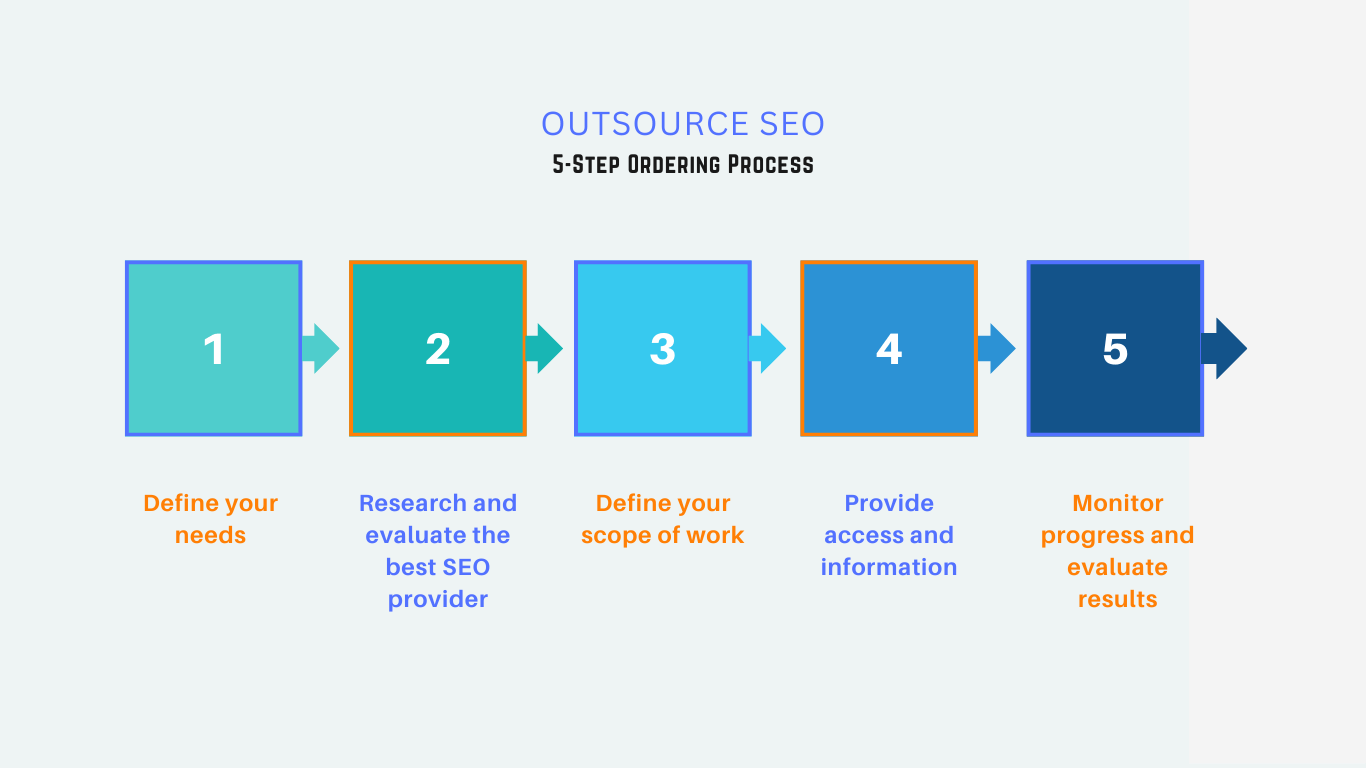
Define your needs:
The first thing is to identify your requirements for the outsourced SEO team. If you are approaching SEO for the first time and your objective is to improve the organic exposure of your brand online, then you should start with keyword research.
Define what you want them to do for you; it may be optimization, link building, or content creation.
For instance, it may be sufficient to need help only in defining keywords and evaluating competitors’ actions to present the in-house content team with a proper concept of what they should concentrate on during the following three months.
On the other hand, you may need help with all forms of SEO, including technical SEO, on-page SEO, local SEO, and brief and link building.
When Does Outsourcing Make Sense?
Consider outsourcing SEO when:
- Your team lacks specialized expertise. If you don’t have in-house professionals who understand the complexities of SEO, outsourcing can fill that gap with seasoned specialists.
- Resources are stretched thin. Managing SEO internally requires time and focus—outsourcing frees up your staff to prioritize core business tasks.
- Results are inconsistent. If your current SEO efforts aren’t delivering steady improvements, a dedicated provider can bring more reliable, measurable outcomes.
- Staying current is a challenge. SEO evolves constantly. Dedicated agencies stay up-to-date with algorithm changes and industry trends so your strategy remains effective.
- Clearly defining your needs and recognizing when your internal resources or expertise fall short will help you determine whether outsourcing is the right path for your business.
Research and evaluate the best SEO provider:
The process to be followed first is to compile a list of candidates that have the characteristics that conform to those that you have set. If possible, it is advised to collaborate with SEO experts. Or SEO firms that have prior experience in your type of business. Trade associations and clickable lists can be used to establish a point where to begin your search. It will help to first skim for people’s reviews and testimonials to get at least an approximate feeling of their work.
In the following steps, get in touch with the final list of your service providers and fix an appointment. Prepare specific questions about their work experience, SEO strategies, and their manner of interacting with clients. Here are some specific questions you can ask:
Could you tell me how much experience you have working with businesses in the sphere of my industry?
May I know examples or perhaps success stories of SEO campaigns you have done an SEO campaign?
It’s important to see real-world proof that an SEO provider can deliver. Ask for case studies, testimonials, or concrete examples of successful projects—ideally, ones relevant to your industry. Reputable SEO outsourcing companies should be able to demonstrate a track record of proven results. This kind of transparency not only builds your confidence but also gives you a clearer picture of what to expect if you move forward with them.
What specific SEO plan do you have in mind for my site?
- What parameters will you use to establish the level of effectiveness of the SEO campaign?
- As for the manner, how are we going to regularly communicate?
- What is your business pricing model?
Define your scope of work:
It will be helpful to understand when choosing an SEO company for services. The objectives should be set, and the expectations or extent of work with a particular company. This minimizes the chances of creating a project that is wrong in some way. It prevents future misunderstandings with the service provider.
This way, they understand exactly what your aims are to be able to assist with their SEO services as per your requirements – traffic, recognition, or sales. Your scope should also indicate exactly what tasks the SEO provider will cover. It can include analyzing keywords, on-page and off-page SEO, link building, and content writing.
Transparent Pricing and Services
You should opt for a clear price structure. Typically, packages are fixed fees or hourly rates with or without a retainer. It is therefore recommended to select the model that fits the specific budget and the requirements of a given project. Ensure the company offers transparent pricing with a clear breakdown of services included. Avoid agencies that offer vague pricing models or hidden fees—know upfront what you’re paying for and what’s included to prevent surprises down the road.
You should formalize the agreement and put it down in black and white in the form of a business contract. It is helpful because a contract shields both participants. It guarantees that everyone is aware of the work being carried out, the deliverables, timeframes, and expenses.
Request a comprehensive proposal from your shortlisted provider:
Once you’ve clarified your scope and budget, ask your preferred SEO provider for a thorough proposal. This document should go beyond the basics and clearly outline:
- Project Scope: A detailed list of tasks and strategies they will undertake, such as keyword research, competitor analysis, technical audits, link building, and content optimization.
- Deliverables: Specific outcomes you can expect, like monthly reports, content pieces, links acquired, or technical improvements made.
- Timeline: Key milestones, expected delivery dates, and an overview of how long each phase will take.
- Performance Metrics: The benchmarks or KPIs used to measure progress (e.g., rankings, traffic increases, lead generation).
- Communication Plan: How and when updates will be provided, and the main point of contact for your business.
- Pricing Structure: Clear explanation of costs, payment terms, and any add-ons or exclusions.
Reviewing such a proposal helps confirm that both you and your SEO partner are fully aligned—reducing the likelihood of surprises down the road.
Provide access and information:
Here, you will allow access to web traffic stats and data from Google Search Console. This data entails the kind of information that your SEO partner needs to understand your website analytics and how users locate your site. Web analytics applications such as Google Analytics are the tools used to monitor traffic to websites. They also monitor the behaviors of website users and conversions. Some of the things that your SEO partner will be able to evaluate by having access to this sort of data are the pages that perform better, the sources of traffic, and the behavior of users. This information is very useful when creating an SEO strategy. It also helps in defining key performance indicators for the efficacy of an SEO campaign.
But the toolkit doesn’t stop there. A seasoned SEO partner will leverage a full suite of professional-grade tools—many of which are too costly or time-intensive for most in-house teams.
These might include:
- SE Ranking for rank tracking, site audits, competitor research, and monitoring emerging features like AI Overviews.
- SERP data platforms to track changes in search result features and spot shifts caused by algorithm updates.
- Screaming Frog and Ahrefs for deep technical SEO audits and comprehensive backlink analysis.
- AI visibility trackers to monitor your presence in AI-driven platforms like ChatGPT, Perplexity, Gemini, and evolving search result presentations.
Beyond just running reports, experienced SEO experts know how to interpret trends—distinguishing whether a ranking drop is due to a technical issue, a search algorithm change, or a content gap. Their pattern recognition comes from working across many industries and campaigns, giving them the judgment to make data-driven recommendations that are tailored to your goals.
By sharing access to the core data—and letting your SEO partner bring their advanced tools and expertise—you lay the groundwork for a truly effective, evidence-based SEO strategy.
Monitor progress and evaluate results:
The other benefit of mapping out the workflow is that it enables you to monitor progress. It guarantees that the work is done according to the plan. SEO is a complex process and comprises a vast number of tasks. It starts with the research of keywords in the given language and finishes with the creation of the proper content.
The activities mentioned above can be used to ensure that the SEO service provider is fulfilling their commitment and meeting the laid-down schedule.
Others may consist of the use of logs to analyze the website traffic. They also use rank and conversion rates to determine the impacts of an SEO campaign. It is also crucial to analyze such data on a regular basis. This will let you know the effectiveness of a certain strategy and what has to be changed. These metrics can be useful in assessing the progress of your SEO strategy.
Conclusion
SEO outsourcing remains one of the most efficient ways for businesses of any size to build organic visibility without carrying the cost of a full in-house team. But the margin for error has narrowed: Google’s Helpful Content system and ongoing core updates mean low-quality, tactic-driven outsourcing can do real damage rather than just underperforming.
The businesses getting the most out of outsourced SEO in 2026 are the ones vetting providers on process, not just price — asking exactly how content gets created and how links get earned, and making sure both hold up to Google’s current standards. Choose a partner who’s transparent about their methods, and outsourcing SEO can be one of the highest-leverage investments you make in your site’s long-term visibility.
Why Outsource SEO in 2026?
When you outsource to an experienced SEO partner, you skip the steep onboarding and training phase that comes with building a team from scratch. Skilled specialists are ready to jump in, leveraging established processes and technical know-how so you can see progress faster.
A Comprehensive, Competitive Strategy
Modern SEO isn’t just about keywords. With AI Overviews now appearing in over 10% of U.S. search results and answer engines like ChatGPT, Perplexity, and Gemini influencing brand visibility, expertise must now cover both classic SEO and Answer Engine Optimization (AEO). The right partner helps you develop an integrated strategy:
- Keyword and topic research
- Multi-channel content creation (blogs, guides, videos, webinars)
- Editorial calendars and topic clusters
- Local SEO (where relevant)
- Link building and digital PR
- All while ensuring synergy with your overall marketing and conversion optimization goals.
- White-Hat Tactics and Long-Term Security
A reputable agency brings a commitment to white-hat practices—earning links the right way and following Google’s Search Essentials. This is crucial for keeping your site’s reputation (and rankings) safe from penalties tied to outdated or black-hat shortcuts like spammy backlink schemes.
Scalable Expertise and Resources
Outsourcing gives you immediate access to toolsets, analytics, and cross-disciplinary skills—often including content marketing, technical SEO, and CRO—that would require significant investment to develop in-house.
Outsourcing SEO isn’t about stepping back. It’s about adding specialized depth where it counts, so you can stay focused on your broader marketing goals while your site climbs the rankings for the terms that matter most.
FAQs — Outsource SEO
- Is it safe to outsource SEO in 2026 with Google’s current algorithm updates?
Yes, as long as the provider follows Google’s Search Essentials and avoids link schemes, cloaking, or mass-produced low-quality content. Outsourcing becomes risky only when a provider uses outdated black-hat tactics; vetting their process for content quality and link building before signing on is the key safeguard.
- How much does it cost to outsource SEO services?
Costs vary based on scope, ranging from a few hundred dollars a month for a narrow project to several thousand for full-service, ongoing SEO management. Pricing is typically structured as a flat monthly retainer, an hourly rate, or a per-project fee, depending on the size of the business and the competitiveness of its industry.
- What’s the difference between hiring an SEO freelancer and an SEO agency?
A freelancer usually costs less and offers more direct, one-on-one communication, but has limited capacity for large or multi-faceted projects. An agency provides a full team covering technical, content, and link-building specialists, making it a better fit for larger sites or more complex SEO needs, typically at a higher price point.
- How does Google’s Helpful Content system affect outsourced content and guest posts?
Google’s Helpful Content system evaluates whether content is created primarily for readers or primarily to manipulate rankings. Outsourced articles and guest posts need genuine expertise, original insight, and human editing to hold up; generic, keyword-stuffed. Or unedited AI content is what this system is designed to demote.
- What questions should I ask before hiring an SEO outsourcing provider?
Ask about their experience in your industry, request case studies with measurable results, and get specific about how they build backlinks and vet guest post placements. Also confirm their content review process, reporting frequency, and pricing structure in writing before signing a contract.