
- October 3, 2026
- by Admin
- SEO
- 0 Comments
Most SaaS companies do not have a traffic problem. They have the wrong traffic problem. A blog can attract thousands of visitors a month and still produce almost no trials, demos, or pipeline. A strong SaaS SEO strategy fixes that. It connects what your buyers search for to what your product solves, and it builds the authority that lets you rank for those searches.
This guide shows you how to build that strategy for 2026. You will learn how to research keywords, fix technical issues, plan content, build topical authority, earn links, and measure results that matter to revenue.
What SaaS SEO Is (and Why It Works Differently)
SaaS SEO is the practice of earning organic search visibility for a software product, so that the right people find you while they research a problem, compare tools, or look for an alternative.
It differs from SEO for e-commerce or local businesses in four ways:
- The buying cycle is long. Buyers read, compare, trial, and involve colleagues before they commit.
- The product is intangible. Searchers cannot touch it, so they rely on content, reviews, and comparisons.
- Revenue is recurring. One customer is worth far more than one sale, so a single well-targeted page can pay for itself many times over.
- Many people decide together. A user, a manager, and a finance lead may all search for different things.
This is why SaaS organic growth rarely comes from a handful of high-volume keywords. It comes from covering the whole journey: the problem, the solution category, your product, and the alternatives.
The three goals of a SaaS SEO strategy in 2026
Every tactic in this guide supports one of three goals:
- Visibility: appear for the searches your buyers make at every stage.
- Credibility: prove expertise through quality content and trusted links.
- Conversion: turn organic visitors into trials, demos, and customers.
Search itself is also changing. Google now shows AI-generated answers on many queries, and people also ask questions in tools like ChatGPT and Perplexity. You can read how Google describes these features in its guide to AI features and your website. The takeaway for SaaS teams is simple: clear, well-structured, authoritative content has a better chance of ranking and of being cited.
How Mavrank helps: We build SaaS SEO plans around revenue goals, not vanity traffic. If you want a clear starting point, our SEO audit shows where your site stands today.
SaaS Keyword Research: Start With Buyer Intent
Keyword research for SaaS starts with intent, not volume. A keyword with 50 searches a month can bring more revenue than one with 5,000 if the searcher is ready to buy.
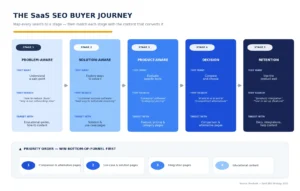
Map keywords to the buyer journey
| Stage | What the searcher wants | Example keyword types |
| Problem-aware | Understand a pain point | “how to reduce churn,” “why is our onboarding slow” |
| Solution-aware | Explore ways to solve it | “customer success software,” “best way to automate invoicing” |
| Product-aware | Evaluate specific tools | “[your category] software,” “[category] pricing” |
| Decision | Compare and choose | “[Brand A] vs [Brand B],” “[competitor] alternatives” |
| Retention | Use the product well | “[product] integration,” “how to set up [feature]” |
A simple keyword research process
- List your core problems. Write down the top problems your product solves, in your customers’ words. Sales calls, support tickets, and onboarding surveys give you the best language.
- Group by intent. Sort keywords into the stages above.
- Study the results page. Check what Google ranks. If the top results are all comparison pages, a blog post will not rank.
- Check competitors. Look at which topics bring them traffic and where they have gaps.
- Prioritize by business value. Score each topic by fit with your product, conversion potential, and difficulty.
Prioritize bottom-of-funnel keywords first
Teams often start with broad educational topics because they have high volume. A better order is:
- Comparison and alternative pages. These capture people about to choose.
- Use-case and solution pages. These match specific needs.
- Integration pages. These attract users of tools you connect with.
- Educational content. This builds reach and authority over time.
Bottom-of-funnel pages convert faster. They also give your educational content a stronger commercial base to support.
How Mavrank helps: Our team can turn keyword research into a prioritized content plan that matches your product and your buyers. See how we approach it in our guide to building a winning B2B SEO campaign.
Technical SEO: Make Your Site Easy to Crawl and Fast to Use
Great content cannot rank if search engines cannot crawl, render, or understand your pages. SaaS sites face some specific technical risks, so check these areas first.
1. Separate your marketing site from your app
Your marketing pages, documentation, and logged-in app should not compete or confuse crawlers. Keep the app behind a login and block it from indexing. Make sure your public pages (features, pricing, use cases, integrations, docs) are fully crawlable.
2. Handle JavaScript carefully
Many SaaS sites use JavaScript frameworks. If key content loads only after scripts run, search engines may miss it. Test important pages with the URL Inspection tool in Google Search Console and confirm that headings, text, and links appear in the rendered HTML.
3. Build a clean site structure
Use a logical hierarchy that mirrors how buyers think:
- Home
- Product and features
- Solutions by use case or industry
- Integrations
- Pricing
- Resources (blog, guides, glossary)
- Documentation and help center
Keep important pages within a few clicks of the homepage. Use descriptive URLs and consistent internal links.
4. Improve page experience
Speed and stability affect both rankings and conversions. Focus on the three Core Web Vitals: loading speed, interactivity, and visual stability. Google explains the metrics and the target thresholds in its Core Web Vitals guide. Compress images, reduce heavy scripts, and avoid layout shifts caused by banners and pop-ups.
5. Add structured data
Structured data helps search engines understand your pages. SaaS companies can use markup for software applications, FAQs, articles, and organization details. Google lists the supported fields in its software app structured data documentation. Validate your markup and only mark up content users can actually see.
6. Fix the common leaks
- Duplicate or near-duplicate pages from filters, parameters, or old URLs
- Broken internal links and redirect chains
- Missing or incorrect canonical tags
- Thin pages that add no value, such as empty tag archives
- Indexable staging or test environments
How Mavrank helps: A technical review catches these issues before they hold back your content. Our SEO audit service covers crawlability, indexation, and site structure, with a prioritized fix list.
SaaS Content Strategy: Write for Buyers, Not Just Search Engines
A SaaS content strategy turns your expertise into pages that rank, build trust, and move readers toward your product. Quantity does not win here. Usefulness does.
Follow the helpful-content principle
Google’s guidance asks you to create content that serves people first. Its page on creating helpful, reliable, people-first content is worth reading with your whole team. In practice, that means:
- Share real experience, such as product insights, customer data, and lessons learned.
- Answer the question completely, without padding.
- Show who wrote the content and why they are qualified.
- Keep information accurate and up to date.
The content types every SaaS site needs
Product-led pages
- Feature pages that explain benefits, not just specs
- Use-case and industry pages
- Pricing pages that answer cost questions clearly
Decision pages
- Comparison pages (“Us vs. Competitor”)
- Alternative pages (“Best alternatives to X”)
- Case studies with real results
Educational content
- How-to guides and tutorials
- Templates, checklists, and calculators
- Glossaries that define category terms
- Original research and benchmark reports
Make every article skimmable and useful
- Put the answer near the top.
- Use clear headings that match how people search.
- Break text into short paragraphs, lists, and tables.
- Add screenshots, examples, and step-by-step instructions.
- Finish with a clear next step, such as a trial, demo, or related guide.
Tie content to your product naturally
Good SaaS content does not just mention your product at the end. It shows the product solving the problem inside the guide. A tutorial on setting up a workflow, for example, can include screenshots of how your tool handles it.
Refresh before you publish more
Update high-potential pages that already rank on page two or three. Improving an existing article often brings results faster than publishing a new one. Review key pages every six to twelve months for accuracy, new examples, and internal links.
Write for answer engines too
AI search tools favor pages that state clear answers, define terms, and organize ideas logically. Use question-style headings, short definitions, and well-labeled sections. This also improves the experience for human readers.
How Mavrank helps: Our content creation service produces expert-reviewed, SEO-ready SaaS articles written to match search intent and your brand voice.
Topical Authority: Own the Topics Your Buyers Care About
Topical authority means search engines see your site as a trusted, thorough source on a subject. You earn it by covering a topic in depth and connecting the pieces clearly.
Build pillar pages and clusters
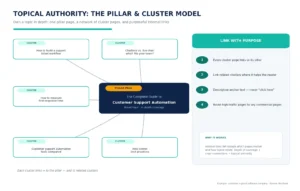
A pillar page covers a broad topic in depth. Cluster pages go deeper on specific subtopics and link back to the pillar. The pillar links out to each cluster page.
Here is an example for a customer support software company:
- Pillar: The Complete Guide to Customer Support Automation
- Clusters:
- How to build a support ticket workflow
- Chatbots vs. live chat: which fits your team
- How to measure first-response time
- Customer support automation tools compared
- Help center best practices
Link your content with purpose
Internal links tell search engines which pages matter and how topics relate. Follow these habits:
- Link from every cluster page to its pillar.
- Link between related clusters where it helps the reader.
- Use descriptive anchor text, not “click here.”
- Link from high-traffic pages to important commercial pages.
Cover the full topic
Before you publish, ask: what would an expert include? List the subtopics, questions, and related terms. Then check whether your pages answer them. Gaps in coverage are often the difference between ranking and being ignored.
Keep the cluster current
Add new cluster pages as the topic evolves. Retire or merge pages that overlap and compete with each other.
How Mavrank helps: We plan topic clusters, write the supporting content, and help you earn links that strengthen the whole cluster. You can read more about outsourcing SEO if you want to understand how an external team fits alongside yours.
Programmatic SEO: Use It Only When It Fits
Programmatic SEO creates many pages from a template and a structured data set. SaaS companies use it for integration directories, template libraries, location or industry pages, and comparison tables.
When programmatic SEO works
It works best when you meet all of these conditions:
- Real search demand exists for the pattern (for example, “[Tool A] + [Tool B] integration”).
- You have unique, useful data for each page, not just swapped keywords.
- Each page answers a real need that a human would find helpful.
- You can maintain quality as the page count grows.
Examples that tend to work
- Integration pages that show how two tools connect, with setup steps and use cases
- Template galleries where each template has a clear purpose and preview
- Industry-specific pages with relevant examples and data
When to avoid it
Skip programmatic SEO if the pages would be nearly identical, if you have no proprietary data, or if you cannot review the output. Google’s spam policies target scaled content created mainly to manipulate rankings. Large numbers of thin pages can hurt your whole site, not just those pages.
Quality checklist before you scale
- Does each page offer something the others do not?
- Would a user find it helpful without knowing it was templated?
- Are internal links and metadata unique and accurate?
- Have you tested a small batch and checked indexing and rankings?
- Do you have a plan to update the pages?
Start small. Launch 20 to 50 strong pages, learn from the results, and expand only if they perform.
How Mavrank helps: We can advise whether programmatic pages suit your product, and we create the in-depth content and links that make those pages credible.
SaaS Link Building: Earn the Authority to Rank
Links remain one of the strongest signals of trust. In competitive SaaS categories, great content alone often stalls without them. SaaS link building focuses on earning links that are relevant, editorial, and valuable to real readers.
What makes SaaS link building different
- Relevance matters more than raw metrics. A link from a respected marketing or software blog beats a link from an unrelated high-authority site.
- Your audience is specific. You want links from sites your buyers actually read.
- The niche is crowded. Many competitors chase the same sites, so quality outreach and original assets stand out.
Link building tactics that work
- Guest posts on relevant sites Write original, useful articles for industry blogs and publications. Share insights the host audience does not already have. Our guest blogging service places expert content on relevant, editorially vetted sites.
- Link insertions in existing articles Some published articles already cover your topic and rank well. A relevant link inserted where it adds value can send both authority and traffic.
- Original data and research Publish surveys, benchmarks, or product usage insights. Journalists and bloggers cite fresh data.
- Linkable assets Create free tools, templates, calculators, and visual guides that people want to reference.
- Integration and partner links Ask partners and integration platforms to feature your tool on their resource or partner pages.
- Unlinked brand mentions Find sites that mention your brand without a link, and ask politely for an update.
- Resource page outreach Suggest your best guide or tool to curated resource lists where it truly fits.
Link quality checklist
Before you accept any link, check that:
- The site is relevant to your industry or audience.
- It publishes real content with real readers.
- The link sits inside a useful, editorial context.
- The anchor text looks natural.
- The site does not sell links openly or publish content for any payer.
Avoid link farms, private blog networks, and mass-produced links. They carry real penalty risk, and 2026’s spam systems detect them more effectively than before.
How many links do you need?
There is no magic number. Study the pages that outrank you, compare their referring domains, and aim for steady, natural growth. Consistent quality beats short bursts.
How Mavrank helps: Our SaaS link building service focuses on relevant, white-hat placements for software companies. For broader needs, explore our full link building service.
Digital PR: Earn Links and Brand Mentions at Scale
Digital PR earns coverage from journalists, analysts, and creators. It builds links, but it also builds brand recognition, which helps in both classic search and AI-driven discovery.
What works for SaaS
- Original research. Share findings from your own data, such as usage trends or customer surveys.
- Expert commentary. Offer your founders and specialists as sources on industry news.
- Product launches with a story. Tie launches to a trend or a problem your market cares about.
- Industry reports and predictions. Publish a point of view that others can quote.
A simple digital PR workflow
- Find the angle. Ask what is new, surprising, or useful to a journalist’s readers.
- Build the asset. Create the data, report, or commentary.
- Target the right outlets. Choose publications your buyers read.
- Pitch with care. Write short, personal outreach that explains why the story matters to that outlet.
- Follow up once. Then move on respectfully.
- Track results. Record links, mentions, and referral traffic.
Digital PR vs. traditional link building
| Link building | Digital PR | |
| Main aim | Targeted, relevant links | Coverage, authority, brand reach |
| Typical output | Guest posts, insertions | News mentions, data stories |
| Speed | Predictable, steady | Variable, can spike |
| Best for | Supporting key pages | Building brand and trust |
The two approaches work best together. Link building provides a steady base. Digital PR adds peaks of visibility and credibility.
How Mavrank helps: We support SaaS brands with outreach, expert content, and placement strategy that builds links and brand authority together.
Measurement: Track What Drives Revenue
If you measure only rankings and traffic, you can win the report and lose the quarter. Measure the full path from search to revenue.
The metrics that matter
Leading indicators (early signals)
- Impressions and clicks for target keywords (Search Console)
- Ranking growth for priority pages
- Referring domains and link quality
- Indexed pages and crawl health
Business indicators (what leadership cares about)
- Organic trial sign-ups and demo requests
- Organic-sourced pipeline and revenue
- Conversion rate by landing page
- Customer acquisition cost from organic vs. other channels
Visibility in AI-driven search
- Whether your brand appears in AI answers for your key topics
- Branded search growth
- Referral traffic from AI tools where you can track it
Set up your tracking
- Connect Google Search Console and your analytics platform.
- Define conversions clearly (trial start, demo request, qualified lead).
- Pass organic source data to your CRM so you can see pipeline impact.
- Create a simple dashboard for monthly review.
Review on a regular cadence
- Weekly: check for technical issues and sudden drops.
- Monthly: review traffic, conversions, content performance, and links.
- Quarterly: reassess priorities, refresh content, and adjust your plan.
Set realistic timelines
SEO compounds. Many SaaS sites see early movement in a few months, and stronger results over six to twelve months, depending on competition and starting authority. Be wary of anyone who promises overnight rankings. If you are evaluating agency pricing, our guide to pay-per-performance SEO explains how performance-based models work and where they can go wrong.
How Mavrank helps: We build reporting around your goals so you can see what SEO contributes to trials, pipeline, and revenue.
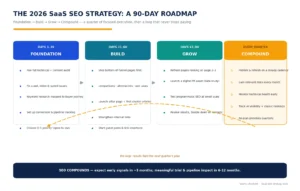
The 2026 SaaS SEO Strategy: A 90-Day Plan
Here is how to put everything together. Use this framework as a starting roadmap and adjust it to your team size and budget.
1. Days 1–30: Foundation
- Run a full technical and content audit.
- Fix critical crawl, index, and speed issues.
- Complete keyword research and map keywords to the buyer journey.
- Set up tracking for traffic, conversions, and pipeline.
- Choose three to five priority topics to own.
2. Days 31–60: Build
- Publish or improve your highest-value bottom-of-funnel pages first (comparisons, alternatives, use cases).
- Launch your first pillar page and its supporting cluster articles.
- Strengthen internal links between related pages.
- Begin link building with guest posts and link insertions on relevant sites.
3. Days 61–90: Grow
- Refresh underperforming pages that already rank on page two or three.
- Launch a digital PR asset, such as a data study or benchmark report.
- Test programmatic pages on a small scale, if the conditions fit.
- Review results and double down on what works.
Ongoing: Compound
- Publish and update content on a steady schedule.
- Keep earning relevant links every month.
- Monitor technical health and fix issues early.
- Track AI-driven visibility alongside classic rankings.
- Review the plan every quarter.
The framework at a glance
| Pillar | Primary goal | Key action |
| Keyword research | Match intent | Prioritize bottom-of-funnel topics |
| Technical SEO | Be crawlable and fast | Audit and fix the foundation |
| Content strategy | Build trust and convert | Publish helpful, product-led content |
| Topical authority | Own your topics | Build pillars and clusters |
| Programmatic SEO | Scale carefully | Launch small, quality-first |
| Link building | Earn authority | Pursue relevant, editorial links |
| Digital PR | Build brand reach | Share data and expert views |
| Measurement | Prove ROI | Track pipeline, not just traffic |
Frequently Asked Questions
- What is the best SaaS SEO strategy in 2026?
The best strategy combines intent-led keyword research, a technically sound site, helpful product-led content, topical authority, and relevant link building. Start with bottom-of-funnel pages, then expand into educational content and authority-building.
- How long does SaaS SEO take to work?
Most SaaS companies see early signals within a few months, such as better rankings and impressions. Meaningful growth in trials and pipeline usually builds over six to twelve months. Timing depends on competition, site authority, and execution quality.
- Is link building still important for SaaS SEO?
Yes. Relevant, editorial links remain a major trust signal, especially in competitive software categories. Focus on quality and relevance over volume, and avoid manipulative schemes.
- Should my SaaS company use programmatic SEO?
Only if you have real search demand, unique data for each page, and can maintain quality. Otherwise, you risk thin or repetitive pages that can harm your site. Start with a small test.
- Which metrics should I track?
Track both leading indicators (impressions, rankings, links) and business metrics (organic trials, demos, pipeline, and revenue). Add visibility in AI-driven search as an emerging metric.
Conclusion: Build SEO That Compounds
A strong SaaS SEO strategy does not rely on one tactic. It connects keyword research, technical health, helpful content, topical authority, links, and measurement into one system that compounds over time. Start with the foundation, focus on buyer intent, and earn authority steadily. Keep quality high, measure what drives revenue, and refine the plan every quarter.
If you want expert help, Mavrank supports SaaS companies with SEO audits, content creation, guest blogging, and SaaS link building. Get in touch with our team to talk about your growth goals.