- October 15, 2026
- by Admin
- Link Building, SEO
- 0 Comments
You can earn backlinks without buying them. It takes more planning than paying for placements, but the links last longer, carry less risk, and tend to come from sites your audience already trusts. Earning a link means giving someone a reason to cite your page on their own. That reason might be original data, a free tool, an expert quote, or a resource that saves their readers time. You then make sure the right people know it exists.
This guide shows you how to earn backlinks without buying them, which tactics work in 2026, and where the line sits between legitimate outreach and manipulative link schemes.
What Does It Mean to Earn Backlinks Without Buying?
A backlink is a link from another website to yours. Search engines treat links as signals of trust and relevance, so pages with strong, relevant links often rank better than pages without them.
Ahrefs describes four ways to get a link: add, ask, earn, or buy. This framework makes the difference clear:
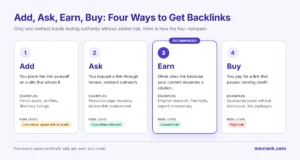
Most real campaigns combine “earn” and “ask.” You build something worth citing, then you contact people who would find it useful.
Which Is Not a Category of Earned Backlinks?
Earned backlinks come from other sites’ free choice to cite you. Paid links and self-placed links do not qualify. If a quiz lists purchased placements, forum signatures, or profile links next to editorial citations, the purchased and self-placed options are the ones that are not earned.
How Mavrank can help: If you want to see which of your existing links are earned and which carry risk, a SEO audit gives you a clear starting point before you plan new outreach.
Why Paid Backlinks Rarely Pay Off
Are paid backlinks worth it? Usually not. Three problems make them a weak investment.
They break search engine rules. Google’s spam policies list buying or selling links for ranking purposes as link spam. Sites that violate those policies may rank lower or disappear from results. Ads and sponsorships are acceptable when the link carries a rel="sponsored" or nofollow attribute, but then the link does not pass ranking credit, which defeats the purpose of buying it for SEO.
They cost real money. Ahrefs reports that its polling of the link industry put the average price of a decent backlink at about $200 to $300. That figure comes from an older article, so current prices may be higher. Either way, you pay every time, and the link can vanish when the contract ends.
They create long-term exposure. A pattern of paid links leaves a footprint. You can lose the investment overnight if a search engine devalues those links, and you may spend months cleaning up your profile.
Ahrefs advises against buying links because of the risk. Sponsorships that grow out of a genuine business relationship are a safer alternative, as long as the link is disclosed properly.
How Mavrank can help: Mavrank offers white-hat link building and content support. Learn more about its link building service if you want help with outreach.
Link Exchanges: Where ABC Swaps Fit (and Where They Do Not)
Link exchanges cost nothing in cash, so many site owners see them as a free shortcut. The reality is more complicated.
A reciprocal link exchange is simple: you link to me, and I link to you. Search engines have long listed excessive link exchanges as link spam.
An ABC link exchange is a three-way variation. Site A links to site B, site B links to site C, and site C links back to site A. The structure hides the direct swap, but the purpose stays the same: trading links to influence rankings. Search engines evaluate link patterns, so the extra step does not make the practice safe.
Ahrefs warns that link exchanges, like guest posts, carry spam-penalty risk if overdone. That makes them a poor foundation for a link profile. Treat them as a practice to avoid at scale, not as a major source of quality backlinks.
What to Do Instead
Natural cross-links between real partners are fine. Two companies that run a joint webinar, publish a co-authored study, or serve the same customers can link to each other when it helps readers. The difference lies in intent and scale.
| Legitimate practice | Manipulative practice |
|---|---|
| Linking to a partner because readers benefit | Trading links on request in large numbers |
| Co-authored research with shared promotion | Three-way swaps arranged only for rankings |
| Linking to sources you cite | Partner pages built only for cross-linking |
| Varied, descriptive anchor text | Repeated exact-match keyword anchors |
| Links on relevant, real sites | Links on sites that exist to sell links |
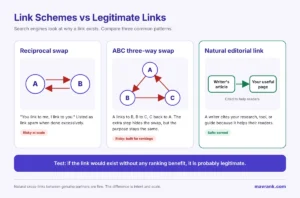
If a link would exist without any ranking benefit, it is probably legitimate. If the only reason for the link is the ranking benefit, search engines may see it as a scheme.
How Mavrank can help: A specialist can review your outreach practices and flag anything that looks like a scheme. Our guide to finding the right link building specialist explains how to vet one.
10 White-Hat Ways to Earn Backlinks Without Buying
You can also build links without guest posting. Tactics 1, 2, 3, 5, 7, 8, and 9 below do not require it at all.
1. Publish Original Research and Data Studies
Original data gives writers something new to cite. Ahrefs points to an agency’s industry survey that attracted links from hundreds of websites, including 570 according to Ahrefs data.
You do not need a huge budget. A survey of 100 customers, an analysis of your own product data, or a roundup of public statistics with a fresh angle can all earn citations. State your method clearly and publish the numbers in a form others can quote.
2. Build Linkable Assets
A linkable asset is a page that people want to reference. Common formats include:
- Free tools and calculators
- Templates and checklists
- Visual guides and infographics
- Glossaries and definitive how-to guides
- Benchmark reports
Backlinko lists charts, original research, free tools, and comprehensive guides as proven linkable formats. Pick the format that matches why someone would link to it. A calculator earns links from resource pages. A study earns links from news and blog articles.
How Mavrank can help: Strong assets need strong writing. Mavrank’s content creation service produces SEO-focused articles and guides.
3. Share Expert Commentary and Run Digital PR
Digital PR means earning coverage in news and industry publications. Reporters often need expert quotes, data points, and fast reactions to news. If you respond with a clear, specific insight, you can earn a mention and a link.
Keep pitches short and relevant. Name the story, offer a quotable claim, and show why you are qualified to speak on it. Our comparison of digital PR vs guest posting explains when each approach fits.
4. Use Editorial and Relationship-Based Outreach
Outreach works best when you build a relationship before you ask for anything. Follow the writers and editors in your niche. Share their work, comment thoughtfully, and offer help when you can.
Expect modest response rates. Tim Soulo of Ahrefs reports that one of his own campaigns earned 19 links from 111 emails, a 17% success rate. He cautions that most responses came from people who already knew Ahrefs, and that a new site would likely see a rate two to three times lower. He also estimates that a cold “my page is great” email may yield about five links per 100 sent.
Backlinko recommends keeping pitches under 200 words and following up five to seven days later.
5. Request Links From Resource Pages and Fix Broken Links
Many sites keep resource pages that list helpful tools and guides. If your page genuinely belongs there, send the editor a short note that explains why.
Broken link outreach adds a second angle. Find a dead external link on a relevant page, then offer your working page as a replacement. This helps the site owner fix a problem, so the request feels useful instead of pushy.
6. Contribute Guest Content the Right Way
Guest contributions still work when they serve the host site’s readers. Pitch topics the audience wants, write original material, and link only where the link adds value. Avoid sites that mainly sell guest post slots, and avoid stuffing posts with keyword-heavy anchors.
Ahrefs notes that guest posting can be a fair exchange when the content is strong, but it also carries penalty risk if overdone.
7. Turn Brand Mentions Into Backlinks
Brand mentions are references to your company that do not yet include a link. Search for your brand name, product names, and founders, then ask the author to link the mention to a relevant page. Most writers say yes when the request is polite and specific.
Backlinko adds that unlinked mentions and co-citations matter for both traditional search and AI search visibility. If you want to understand how this connects to the shift toward AI answers, read our guide to AI Overviews and the future of SEO.
8. Study Competitor Backlinks
Look at the sites that link to competitors but not to you. Ask why each site linked. A resource page, a news mention, and a tool review all call for different outreach. Pick the gaps where you can offer something equal or better.
Software companies can use the same method, and Mavrank’s SaaS link building service serves that niche.
9. Earn Backlinks for Video Content
Video can earn links when it solves a specific problem. Publish a tutorial or demo on your own site, embed it in a written guide, and add a transcript. Writers can then cite the page that holds the video, and the transcript gives them quotable text.
Share the video where your audience already gathers, and email creators and writers who covered the topic. A strong video with a strong page around it gives people two reasons to link.
10. Update and Re-Promote Your Best Pages
A page that earns links today can lose them as it ages. Refresh statistics, fix outdated steps, and add new examples. Then tell the people who linked before, and reach out to new prospects who would care about the update.
Free Backlinks: What Works and What Wastes Time
How do you build backlinks for websites for free? Start with the earned and asked methods above. They cost time instead of cash.
Some free tactics still hold up:
- Business profiles and directories that real people use. A company profile on a respected industry directory helps customers find you, even if the link carries little ranking weight.
- Partner and customer pages. Real partners can mention your product or case study.
- Community participation. Helpful answers in forums and Q&A communities can build visibility, although most links there are nofollowed.
What about profile submission sites with dofollow links? Avoid lists that promise them. Ahrefs calls links you place yourself on forums, profiles, and similar sites low-value, mostly because they are usually nofollowed. Search Engine Journal states that comment spam, private blog networks, and forum posting no longer work well, because search engines have become much better at spotting unnatural patterns.
Use profile links as a starting base for a new site, not as a strategy. Spend most of your time on assets and outreach.
A Step-by-Step Link Earning Workflow
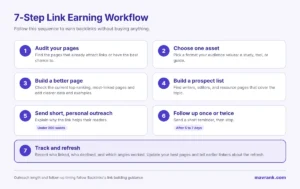
Here is how to create backlinks step by step without buying anything:
- Audit your pages. Find the pages that already attract links or have the best chance to.
- Choose one asset. Pick a format that fits your audience, such as a study, tool, or guide.
- Build a better page than the current leaders. Check what the top-ranking and most-linked pages offer, then add clearer data, better examples, or a more useful format.
- Build a prospect list. Find writers, editors, and resource pages that cover the topic.
- Send short, personal outreach. Explain why the link helps their readers.
- Follow up once or twice. A short follow-up after five to seven days is reasonable. Stop after that.
- Track and refresh. Record who linked, who declined, and which angles worked.
How Mavrank can help: If you lack time for steps 4 to 6, you can ask Mavrank about outreach support, so your in-house team can focus on building the asset.
Tools to Earn and Check Backlinks in 2026
You do not need an expensive stack to start. This table covers the tools most teams use, including free options.
| Task | Tool options | Cost note |
|---|---|---|
| Check your own links | Google Search Console, Bing Webmaster Tools | Free |
| Backlinks checker for competitors | Ahrefs, Semrush, Moz | Paid, with limited free versions |
| Free backlinks checker | Ahrefs’ free backlink checker | Limited data; check current limits |
| Find contact details | Hunter.io, VoilaNorbert | Check current pricing |
| Find journalists | Muck Rack | Paid |
| Track outreach | A spreadsheet or CRM | Free or paid |
Backlinko mentions Hunter.io, VoilaNorbert, and Muck Rack for finding contacts and journalists. Check each tool’s current plans before you commit.
What tools can you use to earn backlinks? None of them earn links on their own. They help you research and organize. The links still come from useful pages and honest outreach.
The 80/20 Rule for Link Earning
What is the 80/20 rule in SEO? It applies the Pareto principle: roughly 80 percent of results often come from 20 percent of causes. Treat it as a useful guideline, not a fixed law.
In link earning, it usually means a small set of pages and tactics bring most of your results. To use it:
- Promote your top one to three assets before you publish more.
- Focus outreach on the sites that fit your audience best.
- Repeat the tactics that earned your first strong links.
- Drop tactics that burn time without results.
You may find that one study or tool earns more links than twenty ordinary blog posts. Invest accordingly.
How to Measure Results
Track more than link counts. A better dashboard includes:
- Referring domains over time, not just total links
- Relevance of the sites that link to you
- Rankings and traffic for the pages you promoted
- Referral traffic from linking pages. Our guide on organic vs direct traffic in GA4 explains how to read those sources correctly.
- Branded search and unlinked mentions
Backlinko suggests running backlink audits quarterly and acting on harmful links only when there is a manual penalty, clear manipulative patterns, or an unexplained ranking drop. Most low-quality links do not need panic or disavow files.
Give campaigns time. Link earning rarely produces overnight changes, and rankings depend on competition and your site’s starting strength.
Can You Do This Yourself?
Can you do SEO on your own? Yes, especially at the start. You can research your audience, publish helpful content, use free tools, and send outreach yourself. The main costs are time and consistency.
Outside help makes sense when you cannot sustain outreach, when your niche is competitive, or when you want an expert to review risk. Our guide to outsourcing SEO covers the benefits and risks. If you decide to get support, contact Mavrank to talk through your goals and what a white-hat plan would look like.
Common Mistakes to Avoid
- Chasing quantity over relevance. A few links from relevant sites beat hundreds from unrelated ones.
- Sending generic pitches. Writers delete mass emails without reading them.
- Over-optimizing anchor text. Repeating the same exact-match phrase looks manipulative.
- Treating link swaps as a system. Excessive reciprocal or three-way exchanges invite problems.
- Ignoring the page itself. A weak asset will not earn links, no matter how many emails you send.
- Giving up too soon. Earned links build slowly and compound over time.
Conclusion
To earn backlinks without buying them, build pages that deserve citations, then bring them to the right people. Original research, linkable assets, expert commentary, relationship-based outreach, and brand mention reclamation all work without hidden payments or risky swaps.
Link exchanges, ABC swaps, and bulk profile links may look free, but they rarely build lasting authority. Put your effort into fewer, stronger assets and honest outreach, and measure the results over months, not days.
Frequently Asked Questions
Are paid backlinks worth it?
Usually not. Buying links for ranking purposes breaks search engine spam policies, costs money repeatedly, and creates risk for your site. Sponsorships and ads are acceptable when you mark the link with rel="sponsored" or nofollow, but those links do not pass ranking credit.
Are link exchanges safe for SEO?
Occasional, natural cross-links between genuine partners are fine. Systematic reciprocal swaps and ABC three-way exchanges aim to influence rankings, and search engines list excessive link exchanges as link spam. Avoid them as a growth strategy.
How long does it take to earn backlinks?
Most campaigns need several months before the results become clear. Timing depends on your niche, the quality of your asset, and how well you promote it. Be cautious about anyone who promises fast, guaranteed links.
Do nofollow links help?
Nofollow links may pass little or no ranking credit, but they can still send referral traffic and raise brand visibility. A natural profile usually includes a mix of followed and nofollow links.
Which is not a category of earned backlinks?
Purchased links and links you place yourself, such as forum signatures or profile links, are not earned. Earned backlinks come from other sites choosing to cite your content without payment or a direct request for a swap.