- October 7, 2026
- by Admin
- Marketing, Pay Per Click
- 0 Comments
Organic traffic is the visits your website receives from unpaid search results. Direct traffic is the visits Google Analytics 4 (GA4) classifies as Direct, which happens when someone uses a saved link or enters your URL, or when GA4 can’t identify the source. The two channels are not interchangeable. Organic traffic connects closely to SEO and search visibility. Direct traffic can signal brand awareness and returning visitors, but it can also reflect missing attribution data.
That last point matters most today. In GA4, direct traffic should not automatically be read as “people who typed our URL.” Google’s own documentation describes Direct as traffic arriving via a saved link or entered URL, yet GA4 also files visits under Direct when source information is missing. Reading the channel correctly changes how you judge SEO performance.
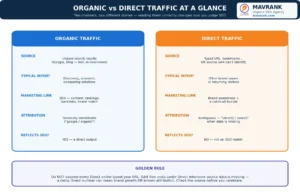
Organic vs. Direct Traffic at a Glance
| Factor | Organic traffic | Direct traffic |
|---|---|---|
| Main source | Unpaid search results | Known direct access or an unattributed source |
| Common example | Google search, then a click to your site | Typed URL or bookmark |
| Marketing connection | SEO | Brand awareness and direct navigation |
| Typical intent | Discovery and research | Often brand-aware or returning |
| Attribution | Generally identifiable | Can be hard to identify |
| GA4 channel | Organic Search | Direct |
| Reflects SEO performance? | Yes | Not directly |
| Attribution gaps? | Less common | Frequent |
Do not assume every Direct visitor typed the URL. Many older articles still claim that, and it is now outdated.
What Is Organic Traffic?
Organic traffic consists of visits that come from unpaid search visibility. The visitor finds your page in the non-ad results of a search engine such as Google or Bing and clicks through. This is also what people mean by “organic traffic in SEO.”
Several factors produce organic traffic:
- SEO and content strategy
- Technical SEO
- Backlinks and topical authority
- Search intent optimization
- Strong rankings for relevant queries
Organic traffic is the opposite of paid traffic. If you pay for a click, such as through search ads, it is not organic. Anything that does not come from unpaid search is “non-organic” traffic, although marketers usually mean paid sources when they use that term.
Example of organic traffic
Someone searches “best SaaS link building strategies,” finds a MavRank article in Google’s unpaid results, and clicks it. GA4 records that visit as organic search traffic.
Why organic traffic matters
- Discoverability: new people find you through problems and questions.
- Qualified visits: searchers often arrive with a specific need.
- Long-term acquisition: a ranking page can keep earning visits.
- Non-branded visibility: you reach people who did not know your name.
- Conversion potential: relevant visitors can become leads or customers.
Google’s GA4 documentation defines the Organic Search channel as visits through non-ad links in organic search results, and it includes Google’s AI Overviews and AI Mode in that channel.
What Is Direct Traffic?
Direct traffic traditionally refers to visitors who reach a website directly, such as by entering its URL or using a bookmark. In GA4, Direct can also represent visits whose original source cannot be clearly identified. Technically, GA4 labels these visits with the source “(direct)” and the medium “(none)” or “(not set).”
Examples of true direct traffic
- Typing your URL into a browser
- Using a browser bookmark
- Opening a saved shortcut
- Entering a known address manually
Why direct traffic can be unattributed
Google lists several reasons traffic can end up in Direct, including missing campaign information, redirects, offline documents, and ad blockers. Common causes include:
- Missing UTM parameters on campaign links
- Untagged email links
- Links inside PDFs and offline documents
- Redirects that drop referral data
- Some app traffic
- Privacy tools and tracking blockers
This is why a rising Direct number does not always mean your brand is growing.
Organic vs. Direct Traffic: Key Differences
1. Traffic source
Organic traffic comes from search engine discovery. Direct traffic comes from direct navigation or from an unknown source.
2. User intent
Organic visitors may be researching a problem, comparing solutions, looking for information, or searching for a brand. Direct visitors may already know your brand, your website, or a specific URL.
Do not assume Direct always equals loyal, high-intent customers. Some Direct traffic is simply unattributed, so the group is mixed.
3. Relationship with SEO
Organic traffic is a direct output of SEO. Direct traffic is not an SEO metric. SEO can still raise brand awareness over time, and that awareness may later lead to more direct visits.
4. Attribution
Organic Search is generally easier to identify. Direct is more ambiguous because it collects traffic that GA4 could not place elsewhere.
5. Conversion potential
Neither channel always converts better. Direct may contain more returning and brand-aware users, while organic may include more new users. Conversion rates depend on intent, landing page, brand strength, industry, and the user journey, so compare your own data.
How organic search compares with direct, referral, and paid
| Channel | What it means | Example |
|---|---|---|
| Organic Search | Unpaid search results | Google result click |
| Direct | Saved link, typed URL, or unknown source | Bookmark visit |
| Referral | Visits from links on other websites | A blog that links to you |
| Paid Search | Clicks on search ads | A Google Ads click |
Referral traffic is different from both channels. It comes from a link on another site, which makes link building a source of referral visits and ranking authority at the same time.
Is Direct Traffic Organic?
No. In GA4, Direct and Organic Search are separate default channels. People sometimes call direct traffic “free” or “non-paid,” but that does not make it organic search. If you want to measure SEO, look at the Organic Search channel.
Why Is Direct Traffic Often Misclassified?
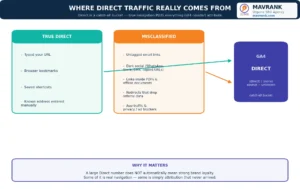
Direct is often a catch-all bucket. These are the usual causes.
Untagged email links
An email campaign without UTM tracking may not receive the attribution you expect, so visits can land in Direct.
Private or “dark social” sharing
Links shared through WhatsApp, Slack, Microsoft Teams, private messages, or copied URLs often pass no referral data.
Links in PDFs and documents
Offline documents can produce Direct classification when referral information is missing. Google lists PDFs and Word documents among examples of offline sources that can end up in Direct.
Redirects
Poorly configured redirects can strip attribution before the visitor reaches your page.
Tracking problems
Broken UTMs, incorrect analytics implementation, tracking blockers, and missing campaign parameters can all push visits into Direct.
Can AI Traffic Appear as Direct Traffic?
AI-driven discovery has made attribution harder. People now find websites through ChatGPT, Gemini, Claude, Perplexity, and other AI assistants. Still, it is not accurate to say all AI traffic is Direct.
GA4 can classify AI traffic separately when it recognizes the source. Google’s current default channel grouping includes an AI Assistant channel for sources such as ChatGPT, Gemini, DeepSeek, Copilot, and Grok. That channel excludes Google’s AI Overviews and AI Mode, which count under Organic Search instead.
Some AI-driven visits can still end up unattributed. It depends on how the user reaches your site and whether the referral information gets passed along. That means Direct may hide some AI discovery, so check your AI Assistant channel and your landing pages before you conclude. Our guide to AI Overviews explains how Google’s AI features relate to SEO.
How to Check Organic and Direct Traffic in GA4
Find organic search traffic
Go to Reports → Acquisition → Traffic acquisition. Find the row labeled Organic Search.
Find direct traffic
In the same report, find the row labeled Direct.
Compare the two
Compare these metrics for each channel:
- Users
- Sessions
- Engaged sessions
- Engagement rate
- Key events (conversions)
- Revenue
- Landing pages
Check source and medium
Do not rely only on the broad channel. Add the Session source / medium dimension to see more detail. Google describes source as the specific platform or location that referred the user, and medium as the broader traffic type, such as organic, referral, email, or none. A Direct visit shows as “(direct) / (none).” Organic search from Google shows as “google / organic.”
Google explains how channels work in its documentation on GA4 default channel groups.
How to Reduce Unattributed Direct Traffic
You cannot eliminate Direct, but you can shrink the unknown part.
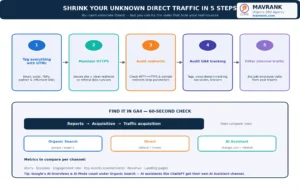
Use UTM parameters
Tag links in email, social campaigns, PDFs, partner campaigns, influencer posts, and offline campaigns. Google explains how to build them in its guide to collecting campaign data with custom URLs.
Maintain HTTPS
Run your site on secure HTTPS with clean redirects, so referral data survives the trip.
Audit redirects
Check HTTP to HTTPS, domain redirects, and URL redirects. Confirm that tracking parameters carry through.
Audit GA4 tracking
Check your tag implementation, cross-domain tracking where it applies, campaign tagging, and referral exclusions where appropriate.
Separate internal traffic
Filter employee and internal activity so it does not distort your reports.
A technical review can catch these problems. An SEO audit is a good place to check redirects, tracking, and site health together.
Which Is Better: Organic or Direct Traffic?
Neither is inherently better. They serve different purposes.
Organic traffic is especially valuable for:
- New customer discovery
- SEO growth
- Non-branded searches
- Content marketing
- Long-term acquisition
Direct traffic is especially useful as an indicator of:
- Brand familiarity
- Returning visitors
- Direct navigation
- Some offline or brand activity
A large Direct number does not automatically mean strong brand loyalty, because Direct includes unattributed traffic. Look at behavior and conversions before you celebrate.
How to Increase Organic Traffic
If your goal is more qualified organic visits, focus on these areas.
- Build search-intent-focused content. Match each page to what the searcher wants. Our guide to SEO content writing services explains how research-led content works.
- Improve existing content. Update pages that rank but are slipping or outdated.
- Strengthen internal linking. Help readers and crawlers move between related pages.
- Build high-quality backlinks. Relevant editorial links build authority. See our link building service, and for software companies, our SaaS link building service.
- Improve technical SEO. Fix crawling, indexing, speed, and structure problems.
- Target topic clusters. Cover a subject in depth with connected pages. Our SaaS SEO strategy guide shows how.
- Optimize for search and AI discovery. Clear answers, credible sources, and original information help in both.
Persuasive page copy also helps organic visits convert, which is where SEO copywriting services come in. A combination of SEO content, technical optimization, and authoritative link building can help businesses grow qualified organic visibility over time. Our content creation service supports the content side.
Organic vs. Direct Traffic FAQs
What is the difference between organic and direct traffic?
Organic traffic comes from unpaid search results. Direct traffic is classified as Direct when someone uses a saved link or enters your URL, or when GA4 cannot identify the source. Organic reflects SEO visibility. Direct reflects navigation and missing attribution.
Is direct traffic better than organic traffic?
Neither is better in every case. Organic brings new visitors from search. Direct may include returning, brand-aware visitors, but it also includes unattributed visits. Judge each channel by engagement, conversions, and revenue.
Does direct traffic mean someone typed my URL?
Not always. Direct includes typed URLs and bookmarks, but GA4 also uses it when the source is missing. Redirects, untagged links, offline documents, and tracking blockers can all cause this.
Why is my direct traffic increasing?
It could reflect real brand growth, more returning visitors, or attribution gaps. Check landing pages, new campaigns, redirects, email tagging, and tracking changes before you decide.
Can email traffic appear as direct traffic?
Yes. Email links without UTM parameters, or traffic from some email apps, may not pass source information. Tag every email link so GA4 can credit the Email channel.
Can AI traffic appear as direct traffic?
Sometimes. GA4 has an AI Assistant channel for recognized sources such as ChatGPT and Gemini, but some visits may still arrive without referral data. Google’s AI Overviews and AI Mode count under Organic Search.
How do I see organic traffic in GA4?
Go to Reports, then Acquisition, then Traffic acquisition. Find the Organic Search row. Add source and medium to see more detail, and compare engagement and key events against other channels.
How can I increase organic traffic?
Publish helpful content built around search intent, update older pages, improve internal linking and technical SEO, and earn quality backlinks. Measure results by qualified visits and conversions.
Final Takeaway
Organic traffic and direct traffic are not competing channels. They tell you different things about how people reach your website. Organic traffic shows how well you do in unpaid search. Direct can represent direct navigation as well as traffic whose original source was not captured.
In modern GA4, accurate interpretation means looking beyond the channel name to source, medium, campaigns, landing pages, and conversions.
Want to increase qualified organic traffic? Explore MavRank’s SEO audit, content, and link building solutions, or contact our team to discuss your goals.