
- April 12, 2026
- by Admin
- Content Writing
- 0 Comments
Most businesses do not have a content shortage. They have a results shortage. The blog has fifty posts, the team keeps publishing, and organic traffic stays flat or brings visitors who never become leads. The cause is rarely effort. It is usually a weak plan. Articles get written around keywords nobody checked for intent, copied from what competitors already say, and published without a next step for the reader. Strong SEO content writing services fix that by treating each article as part of a system: research, strategy, writing, optimization, and measurement. That is the difference between content that fills a website and content that grows a business. Good SEO writing services also plan what to publish, not only how to write it, which is why an SEO content strategy comes first.
This guide explains what SEO content services include, how a professional process works, what types of content to prioritize, how AI changes the picture, how much the work costs, and how to choose an SEO content agency or writer. Google also makes the standard clear: it wants helpful, reliable, people-first content, not pages made mainly to rank. You can read its guidance on creating helpful, reliable, people-first content.
What Are SEO Content Writing Services?
SEO content writing services are professional services that plan, write, optimize, and maintain content designed to attract qualified organic traffic and support business goals. You may also see them called SEO content services, SEO writing services, or content writing for SEO. The labels differ, but a complete service usually combines:
- Keyword research
- Search intent analysis
- Competitor and SERP analysis
- Content strategy
- Content briefs
- Expert research
- SEO-focused writing
- On-page optimization
- Internal linking
- Conversion optimization
- Updates and refreshes
- Performance monitoring
The key point: SEO writing is not inserting keywords into an article. A writer who only sprinkles phrases into a draft is doing half the job at best. Professional SEO content writing starts with research before the first sentence and continues with optimization after publishing.
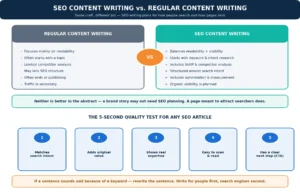
SEO Content Writing vs. Regular Content Writing
| Regular content writing | SEO content writing |
|---|---|
| Focuses mainly on readability | Balances readability and search visibility |
| Often starts with a topic | Starts with keyword and intent research |
| Limited competitor analysis | Includes SERP and competitor analysis |
| May lack SEO structure | Structured around search intent |
| Often ends at publishing | Includes optimization and measurement |
| Traffic is secondary | Organic visibility is planned |
Neither is better in the abstract. A brand story or a thought-leadership essay may not need SEO planning. A page meant to attract searchers needs it.
Why SEO Content Writing Matters for Organic Growth
Ranking is not the goal. Business results are. SEO content helps in four practical ways.
It attracts qualified organic traffic
Traffic and the right traffic are not the same. A page that ranks for a broad term may bring thousands of casual visitors. A page built for a specific problem often brings fewer visitors who are far more likely to inquire. Good content strategy aims at relevant, commercial-intent traffic and, eventually, qualified leads.
It builds topical authority
Search engines look at how well a site covers a subject. A pillar page supported by detailed articles, connected by internal links, shows depth. Topic clusters, semantic relationships, and logical linking help both readers and crawlers understand what you know.
It supports every stage of the buyer journey
A good SEO content strategy maps content to what people need at each stage:
- Top of funnel (informational): guides and explainers for people learning about a problem.
- Middle of funnel (commercial investigation): comparisons, checklists, and “how to choose” content.
- Bottom of funnel (transactional): service pages, pricing explanations, and demo-oriented pages.
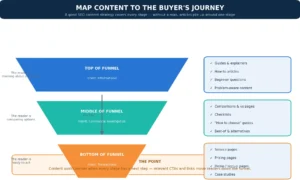
Without that map, even well-written articles tend to pile up around the same stage and leave gaps where buyers decide.
It turns search traffic into leads and customers
Content works harder when it points somewhere. Relevant calls to action, links to service pages, lead magnets, product recommendations, and demo or signup prompts give readers a natural next step. Structure matters too: scannable headings and clear answers help people reach that step.
How MavRank helps: Our content creation service connects each piece to a business goal, so articles do more than collect pageviews.
What Does an SEO Content Writing Service Include?
A serious provider delivers an end-to-end process. Here is what should be on the list.
Keyword research
Good research looks past search volume. It considers business relevance, search intent, keyword difficulty, long-tail terms, commercial keywords, question-based queries, and keyword clusters. A keyword with 200 monthly searches that matches buying intent can beat one with 20,000 searches that does not.
Search intent analysis
Every query has a purpose, usually one of four:
- Informational: the searcher wants to learn.
- Navigational: they want a specific site or page.
- Commercial: they are comparing options.
- Transactional: they are ready to act.
Intent decides the content type, structure, depth, call to action, and keyword targeting. A comparison query needs a comparison, not a definition.
Competitor and SERP analysis
Writers should study ranking pages, heading structures, topics covered, gaps, SERP features, FAQs, formats, and where first-hand insight is missing. The goal is not to include everything competitors include. Cover the important subtopics they address, then add something more useful or original. Google’s guidance rewards substantial added value, not rewrites of existing pages.
SEO content brief creation
A strong brief saves time and prevents off-target drafts. It should include the primary and secondary keywords, intent, target audience, article goal, suggested title, heading structure, competitor insights, questions to answer, internal links, external sources, call to action, content angle, and a recommended word range.
Expert and original content research
This is where content separates itself. Original input might include subject-matter interviews, first-hand experience, customer data, case studies, expert commentary, original research, or unique frameworks. Google’s guidance repeatedly highlights originality, expertise, effort, and accuracy.
SEO-friendly content writing
SEO-friendly content writing combines natural keyword use with clear structure, short paragraphs, descriptive headings, topic and entity coverage, examples, data, internal links, strong introductions, and helpful conclusions. The goal is SEO optimized content that still reads like a person wrote it for another person. If a sentence sounds odd because of a keyword, rewrite the sentence.
On-page SEO optimization
This covers the SEO title, meta description, H1, H2 and H3 hierarchy, URL, image alt text, internal links, external references, anchor text, and schema where appropriate. Google’s SEO Starter Guide explains many of these basics.
Conversion optimization
Ranking is valuable. Ranking and generating business is better. Add relevant calls to action, contextual service links, lead magnets, trust signals, and social proof where they help the reader decide.
Content refresh and optimization services
Content ages. Rankings slip, statistics go stale, new competitors appear, and search intent shifts. Content optimization services address this by fixing outdated facts, adding missing sections, repairing broken links, improving internal links, consolidating overlapping pages, and capturing new keyword opportunities. Many businesses get more return from updating a decent post than from publishing a new one.
Our SEO Content Writing Process
Here is a nine-step process that works for most projects. Adjust the depth to the size of the program.
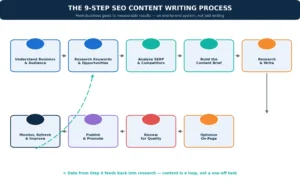
Step 1: Understand your business and audience. We start with your industry, ideal customer, products or services, customer pain points, competitors, and business objectives. Without this, content drifts.
Step 2: Research keywords and opportunities. We find keywords, check intent, judge commercial value, and group terms into clusters and topics.
Step 3: Analyze the SERP and competitors. We study ranking content, gaps, search features, and weaknesses we can improve on.
Step 4: Build the content brief. The brief defines intent, outline, keywords, questions, internal links, call to action, and angle.
Step 5: Research and write. Writers gather expert input, original insights, and supporting data, then draft in a clear, human voice.
Step 6: Optimize on the page. We refine titles, headings, metadata, internal links, topic coverage, images, and schema where it fits.
Step 7: Review for quality. Before delivery, an editor checks accuracy, readability, originality, search intent, brand voice, grammar, factual claims, links, and SEO requirements.
Step 8: Publish and promote. Publishing includes internal linking, relevant backlink opportunities, social and email distribution, and digital PR where appropriate.
Step 9: Monitor, refresh, and improve. We track rankings, impressions, clicks, organic traffic, engagement, conversions, assisted conversions, and new keyword visibility, then update content based on the data.
How MavRank helps: If you are unsure which content to fix first, a SEO audit can show where your current pages lose traffic and which topics offer the best return.
Types of SEO Content We Write
Different goals call for different formats.
- SEO blog writing services: Regular posts that earn traffic, answer common questions, and build trust.
- SEO article writing services: Longer, research-heavy articles and guides that cover a topic in depth.
- Pillar pages and topic clusters: A central page supported by related articles.
- Service page content: Pages that explain what you offer and convert interested visitors.
- Product page content: Clear, accurate descriptions that help buyers decide.
- Landing page content: Focused pages built around a single action.
- Comparison and alternative pages: “X vs. Y,” “best X,” “X alternatives,” pricing, and review pages for buyers in evaluation mode.
- Case studies: Proof that shows how you solved a real problem.
- Industry-specific content: Material written with niche knowledge and terminology.
- Thought leadership: Perspective pieces that build authority.
- Local SEO content: Location-focused pages and articles for nearby customers.
- E-E-A-T-focused content: Pieces that show experience, expertise, and trust through expert input, clear authorship, sources, and first-hand experience.
SEO Content Writing for Different Business Types
Each audience needs a different approach.
SaaS and technology companies need product-led content, comparison pages, integration guides, and educational articles. Search intent often moves from problem-aware to solution-aware. Content can attract trial signups and demo requests. For a deeper plan, read our guide to SaaS SEO strategy.
E-commerce businesses need category and product page copy, buying guides, and comparison content. Intent is often commercial or transactional, and content supports both discovery and conversion.
B2B companies benefit from long-form guides, case studies, and thought leadership aimed at buying committees. Content can shorten sales cycles by answering questions before a sales call.
Professional services such as law, finance, or consulting need trust-driven content. Clear expertise and accurate information matter most.
Agencies often need dependable content production for several clients at once. Scalable, consistent quality is the priority.
Startups need focused content around a few high-value topics instead of broad coverage. Early content can establish credibility and attract first customers.
Local businesses need location pages, service-area content, and answers to local questions. Content helps them show up where nearby customers search.
AI and SEO Content Writing: What Has Changed?
The question is no longer “is AI content bad?” It is “how do you use AI without producing forgettable content?”
Can AI be used to create SEO content?
Yes, with limits. AI can help organize research, generate ideas, and draft outlines or first versions. Human review remains essential, because AI can state wrong facts confidently. AI does not replace expertise, original insight, or editorial judgment. Generic, mass-produced AI output adds little differentiation, and many competitors can generate the same thing.
Google’s position is that the key issue is how and why content is created, not the tool. It warns against scaled content produced mainly to manipulate rankings. Its guidance on using generative AI content is worth reading.
AI-assisted vs. AI-generated content
| AI-assisted content | AI-generated content |
|---|---|
| A human leads strategy and writing | AI produces most of the draft |
| Experts add insight and examples | Little original input |
| Editors verify every claim | Often published with minimal review |
| Serves a clear reader need | Often scaled for volume |
| Lower risk | Higher risk of errors and thin content |
Optimizing content for AI search
People now find answers in AI Overviews, AI Mode, and assistants such as ChatGPT, Gemini, and Perplexity. The fundamentals still apply. Content that gets referenced tends to have clear answers, strong topical coverage, original information, credible sources, clear entities, structured information, direct answers to questions, and visible author or expert credibility. Google says SEO best practices remain relevant for its AI features, as covered in our guide to AI Overviews.
What Makes High-Quality SEO Content?
Use this framework to judge any article, whether you wrote it or hired someone.
- It matches search intent. The page gives the reader the type of answer they came for.
- It provides original value. It adds something a competitor’s page does not.
- It shows expertise. The author understands the topic and says so through detail, not slogans.
- It is easy to read. SEO-friendly content writing uses short paragraphs, plain words, and clear headings.
- It is well structured. Readers can scan and find what they need, and search systems can understand each section.
- It uses data and reliable sources. Claims are backed by credible references.
- It answers the real question. It does not wander or pad.
- It helps the reader take the next step. A clear, relevant call to action guides them.
- It stays current. Facts, screenshots, and examples get updated.
Common SEO Content Writing Mistakes to Avoid
- Keyword stuffing. Repeating phrases unnaturally hurts readability and invites quality problems.
- Writing only for search engines. Readers notice, and so do search systems.
- Ignoring search intent. A guide cannot rank for a query that wants a product comparison.
- Copying competitors. Rewording what already exists adds no value.
- Publishing generic AI content. Unreviewed output tends to be shallow and error-prone.
- Chasing volume over business value. High-volume terms may never convert.
- Ignoring internal linking. Links help readers and distribute authority.
- Publishing without a content strategy. Random posts rarely build authority.
- Never updating old content. Stale pages lose rankings and trust.
- Measuring traffic instead of results. Leads and revenue tell the real story.
How to Choose the Right SEO Content Writing Services
Choosing professional SEO content writing is easier when you know what to ask. Look beyond sample articles and price lists.
- SEO plus writing expertise. A great writer without SEO knowledge, or an SEO specialist without writing skill, will leave gaps. A good SEO content writer needs both.
- Content strategy. Ask whether the provider plans an SEO content strategy or only delivers articles on a list you supply.
- Research process. Ask how they select topics and gather information.
- Intent analysis. They should explain how they decide what each page must do.
- Published work. Read samples. Check structure, accuracy, and voice.
- Industry knowledge. Niche understanding reduces revisions.
- Expert input. Ask how they gather subject-matter insight.
- Revision process. Know how many rounds you get and how feedback works.
- On-page optimization. Confirm that titles, metadata, links, and schema are included.
- Content refreshes. Find out whether they update existing pages.
- Measurement. Ask what they track and report.
- AI policy. Ask how, and whether, they use AI, and who reviews the output.
- Proof. Request case studies and references.
SEO Content Writer vs. Freelancer vs. Agency vs. Content Platform
| Option | Best for | Advantages | Limitations |
|---|---|---|---|
| Freelance SEO writer | Small content programs | Flexible, direct communication | Limited scalability |
| Content platform | High-volume production | Scalable | Quality can vary |
| SEO content agency | Growth-focused businesses | Strategy, writing, and optimization together | Higher investment |
| In-house team | Large organizations | Maximum control | Hiring and management costs |
There is no universal winner. A freelance SEO content writer suits small programs. An SEO content writing agency suits teams that want strategy, writing, and optimization together. Match the option to your volume, budget, and how much planning you want from the partner. If you are weighing whether to outsource at all, our guide to outsourcing SEO the right way covers the trade-offs.
How Much Do SEO Content Writing Services Cost?
Prices vary too much for a single reliable number, and quoted figures go stale quickly. Instead of chasing a “standard” rate, understand what drives the cost.
What affects the price
- Research depth: More original research costs more than a summary of known facts.
- Content length and complexity: A 600-word post and a 4,000-word guide are different jobs.
- Industry expertise: Technical or regulated topics need specialist writers.
- Subject-matter interviews: Expert access adds time and cost.
- Keyword competition: Competitive topics need deeper content.
- Content strategy: Planning and briefs add value beyond the writing.
- Editing and optimization: Review and on-page work take time.
- Publishing and promotion: Formatting, uploads, and outreach are extra effort.
Common pricing models
- Per word: Simple, but it rewards length over quality.
- Per article: A fixed price for a defined piece.
- Monthly retainer: A recurring fee for an ongoing program.
- Project-based: One price for a set scope, such as a pillar page and supporting articles.
- Content package: A bundle of articles or pages at a set price.
Whatever the model, ask for a written scope that lists exactly what is included. Then compare providers on equal terms. To get a scope for your own project, contact MavRank.
How to Measure the ROI of SEO Content Writing
Do not judge a campaign by how many articles were published or how many pageviews arrived. Track the signals that connect to business results:
- Organic impressions: Are more people seeing your pages in search?
- Organic clicks: Are they choosing your results?
- Keyword rankings: Are target terms improving?
- Non-branded organic traffic: Are new people finding you without searching your name?
- Qualified organic traffic: Are the visitors the right audience?
- Leads and conversions: Are they filling forms, booking calls, or signing up?
- Assisted conversions: Did content help earlier in the journey?
- Revenue from organic search: What business value did it create?
- AI search visibility: Does your content get referenced in AI answers? Tools are still developing here, so combine manual checks with Search Console trends.
Google Search Console is the best free starting point for impressions, clicks, and queries. Pair it with analytics for conversions.
Why Choose MavRank for SEO Content Writing Services?
MavRank is an SEO company that offers content creation, link building, SaaS link building, guest blogging, and SEO audits, with a focus on white-hat SEO. That mix matters for SEO content services, because articles rarely rank on writing quality alone. Authority, internal structure, and technical health also play a role.
Here is how we approach content:
- SEO-first strategy. We plan content around search demand and business goals, so every article supports a wider SEO content strategy.
- Research-driven writing. Each piece starts with intent, competitor, and topic research.
- Human-reviewed quality. Editors check clarity, accuracy, and grammar before delivery.
- Search intent focus. Every page is built for what the searcher wants.
- Optimization and refreshes. We improve published content, not only create new pieces.
- Connected off-page support. Content can be paired with link building, guest blogging, and SaaS link building for stronger authority.
- Agency-friendly support. We work with agencies that need SEO fulfillment help. See our guide to choosing a white label SEO partner and what to ask any provider, including us.
Frequently Asked Questions About SEO Content Writing Services
What are SEO content writing services?
They are professional services that research, plan, write, optimize, and update content to attract qualified organic traffic. A full service includes keyword and intent research, briefs, SEO optimized content, on-page SEO, internal linking, and performance tracking.
What does an SEO content writer do?
An SEO content writer researches search intent, follows a content brief, writes clear and useful copy, and applies on-page SEO. Strong writers also use expert input, cite sources, and update content over time.
How is SEO writing different from regular content writing?
Regular writing focuses mainly on the message and the reader. SEO writing services also consider how people search, what competing pages offer, and how a page should be structured to rank. Both should serve the reader first.
How much do SEO content writing services cost?
It depends on research depth, length, industry, competition, and the amount of strategy and optimization included. Common models are per word, per article, monthly retainers, project fees, and packages. Compare written scopes, not only prices.
How long does SEO content take to rank?
There is no fixed timeline. Results depend on competition, site authority, content quality, and consistency. Many sites see early movement in a few months, but competitive topics can take longer. No honest provider can guarantee a ranking date.
Can AI write SEO content?
AI can assist with research, ideas, and drafts. It should not replace human expertise, fact-checking, and editing. Google’s concern is low-value content created at scale, not the use of AI itself.
Is SEO content still effective in 2026?
Yes. People still search, and content still answers their questions. The standard has risen, though. Original, helpful, well-structured content performs better than thin or repetitive pages.
How often should I publish SEO content?
Consistency matters more than a fixed number. Publish at a pace you can sustain without lowering quality. For many businesses, a few strong articles a month beat a dozen weak ones.
Should I update old blog posts or create new ones?
Do both. Update pages that rank but are declining or outdated, and create new content for topics you do not cover yet. Refreshing a page that already has some authority is often faster than starting over.
Can SEO content writing help with AI search visibility?
It can. Clear answers, strong topical coverage, credible sources, and original information make content easier to reference. Google says SEO best practices remain relevant for its AI features.
Turn Your Content Into an Organic Growth Engine
Publishing more content is not necessarily the answer. Publishing the right content is content with clear intent, real research, visible expertise, careful optimization, and a path to a business result. If your blog is busy but your leads are not growing, the problem is probably strategy, not volume. Start by finding what to fix, then build a plan that connects each article to a goal.
Ready to turn your content strategy into a measurable SEO growth channel? Talk to MavRank about your SEO content writing needs, or explore our content creation service.