- July 5, 2026
- by Admin
- Marketing, SaaS Growth
- 0 Comments
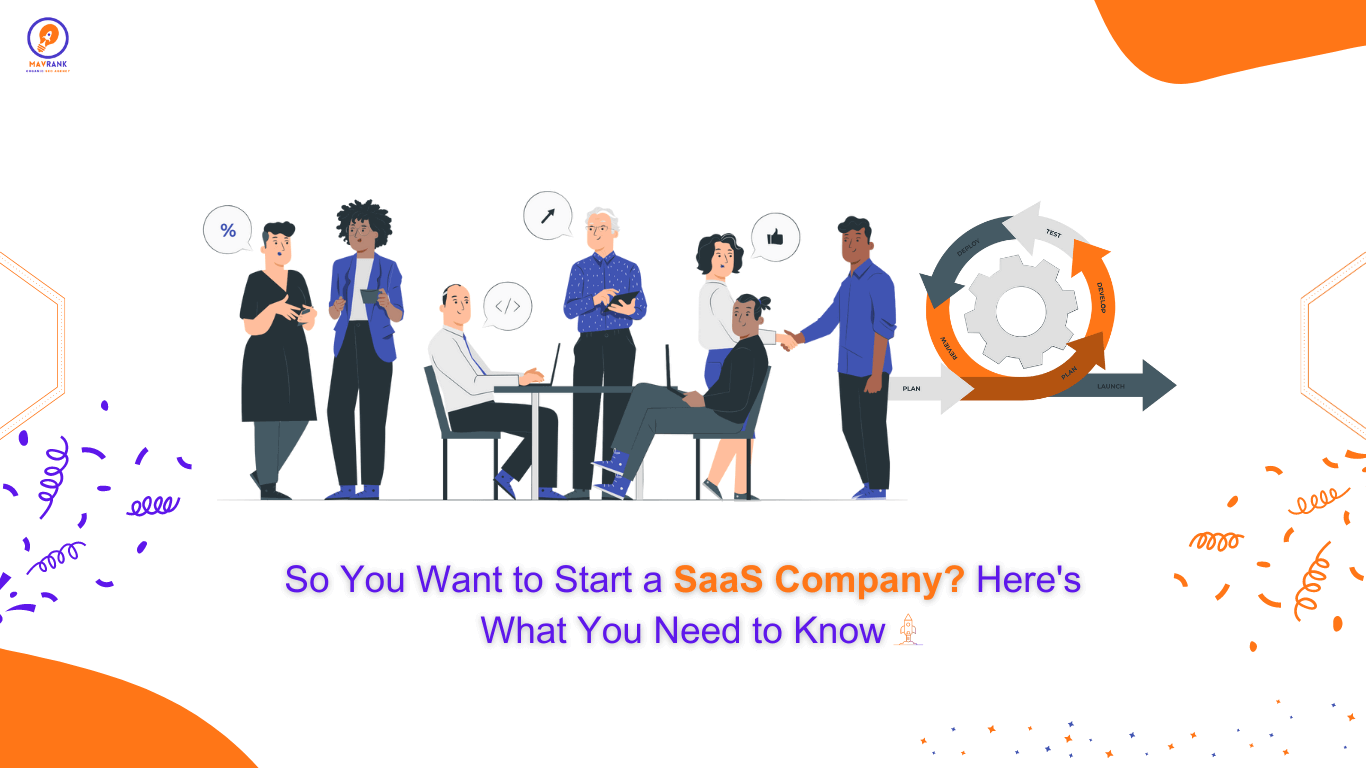
Most people think starting a SaaS company means building software. It does not, at least not first. It means finding a painful problem, proving people will pay to solve it, building the smallest useful solution, and creating a repeatable way to win and keep customers. Founders who skip the first two parts often spend six months building a product nobody buys. Founders who follow the order below spend less, learn faster, and reach their first paying customers sooner.
This guide shows how to start a SaaS company from scratch. You will learn how to:
- Find a SaaS idea and validate it before coding
- Define your ideal customer profile and research competitors
- Build an MVP, including with AI and no-code tools
- Price your product and choose a business model
- Win your first customers and launch
- Market the company and set up SaaS SEO
- Track the metrics that matter and plan your first 90 days
What Is a SaaS Company?
A SaaS company sells software as a service. Customers access the product over the internet, usually through a subscription, instead of buying and installing it once. The U.S. National Institute of Standards and Technology describes this model in its definition of cloud computing. In plain terms, what is considered a SaaS company? One that hosts software, keeps it updated, and charges customers for ongoing access. The phrase “SaaS startup” simply means an early-stage company building such a product.
SaaS vs. Traditional Software
| Traditional software | SaaS |
|---|---|
| Installed on the customer’s device or server | Accessed through a browser or app |
| One-time license fee | Subscription or usage-based fees |
| Customer manages updates | Provider ships updates continuously |
| Support is often separate | Onboarding and support are part of the service |
How Does a SaaS Company Make Money?
Common models include monthly or annual subscriptions, usage-based pricing, per-seat pricing, freemium, hybrid pricing, and custom enterprise contracts. Revenue repeats, so retention matters as much as acquisition.
Examples of SaaS Business Models
You can find SaaS in almost every category: CRM, project management, marketing, accounting, HR, customer support, developer tools, and AI products. If you serve other companies, you are building a B2B SaaS company. Our guide to B2B SaaS explains how that model works in detail.
Is Starting a SaaS Company Right for You?
Advantages
- Recurring revenue: customers pay over time.
- Global reach: you can sell online from day one.
- Scalability: the same software can serve many customers.
- Potentially high gross margins: software costs per additional customer can be low.
- Automated onboarding: self-serve flows reduce manual work.
- Multiple acquisition channels: SEO, partnerships, content, and outbound all work.
Challenges
- Product development takes time and skill.
- Customer acquisition is expensive and slow.
- Churn can erase growth.
- Infrastructure and security need ongoing attention.
- Support takes time.
- Competition is intense.
- Cash flow can be tight while revenue grows.
SaaS Is Not “Build Once and Get Paid Forever”
A SaaS company runs on a loop:
Build → Measure → Learn → Improve → Sell → Retain
The loop never stops. If you want a business that runs itself after launch, this is not it. If you enjoy solving a problem repeatedly, it can be a strong model.
How to Start a SaaS Company in 12 Steps
Step 1: Find a Painful Problem Worth Solving
Start with a problem, not a feature. Ask:
- What do people complain about repeatedly?
- Which tasks are slow or expensive?
- Which workflows are still manual or live in spreadsheets?
- Which existing software frustrates its users?
- Which industries are underserved?
If you need SaaS business ideas, look at niche workflows in industries you know, such as compliance reporting for clinics, scheduling for trades, or content approvals for agencies.
A good SaaS problem is usually:
- ☐ Frequent
- ☐ Painful
- ☐ Expensive
- ☐ Urgent
- ☐ Currently solved poorly
- ☐ Felt by customers with budget to pay
The more boxes you check, the stronger the idea.
Step 2: Define Your Ideal Customer Profile
Decide exactly who your first customer is. Describe their industry, company size, job title, budget, current workflow, pain points, buying triggers, existing tools, decision-maker, and end user.
Example ICP: B2B SaaS marketing agencies with 5 to 30 employees that struggle to produce SEO content at scale.
A narrow ICP helps you write sharper messaging, build a focused product, and find customers faster. “Small businesses” is not an ICP.
Step 3: Validate Your SaaS Idea Before Building
SaaS idea validation should happen before significant development. Behavior is stronger validation than compliments. A friend saying “great idea” proves nothing. A customer paying or committing to a pilot does.
Talk to potential customers. Ask:
- How do you solve this problem today?
- How often does it happen?
- What does your current solution cost?
- What frustrates you about it?
- Which tools have you tried?
- Who decides on a purchase?
- What would make you switch?
Listen more than you pitch. If people struggle to describe the problem, it may not be urgent.
Build a landing page. Describe the problem, solution, value proposition, and benefits, then add a call to action such as a waitlist or demo request. Track how many qualified visitors sign up.
Create a clickable prototype. Mockups let users react to a flow before you write code.
Run a concierge MVP. Deliver the result manually, with spreadsheets and email, before you automate anything. It shows you what customers actually value.
Get pre-signups or paid pilots. A deposit or a signed pilot agreement is the best proof.
Step 4: Research the Market and Competitors
Competitor research should produce decisions, not a long list of names.
- Direct competitors: products that solve the same problem for the same customer.
- Indirect competitors: different solutions to the same need, including spreadsheets and agencies.
- Existing alternatives: what customers use today, including doing nothing.
Review features, pricing, target audience, positioning, reviews, complaints, strengths, weaknesses, and marketing channels. Then look for the gap. Ask: what could your SaaS do significantly better, faster, cheaper, or more simply?
Use a positioning matrix:
| Competitor | Target customer | Main problem solved | Pricing | Strength | Weakness |
|---|---|---|---|---|---|
| Competitor A | |||||
| Competitor B | |||||
| Competitor C |
Customer reviews often reveal weaknesses faster than any feature comparison.
Step 5: Define Your Value Proposition
Answer three questions:
- Who is the product for?
- What problem does it solve?
- Why is it better than the alternatives?
Use this formula:
For [target customer], [product] helps them [achieve outcome] without [major pain or friction].
A strong value proposition also covers your differentiation, positioning, core outcome, and competitive advantage. If you cannot state it in one sentence, your messaging needs work.
Step 6: Choose Your SaaS Business Model
Pick how you will charge. The main SaaS pricing models are:
- Subscription-based: monthly or annual fee for access.
- Usage-based: price follows consumption, such as API calls or storage.
- Per-seat: price scales with users.
- Freemium: a free plan with paid upgrades.
- Free trial: full access for a limited time.
- Enterprise: custom contracts for large buyers.
- Hybrid: a base fee plus usage or add-ons.
Which SaaS pricing model should you choose? Use these criteria:
- How does your customer get value? If value grows with users, per-seat fits. If it grows with consumption, usage-based fits.
- How complex is the buying process? Simple products suit self-serve plans. Complex ones suit demos and custom quotes.
- What are your costs? Make sure pricing covers variable costs such as compute or messaging.
- How do competitors charge? Match customer expectations, then differentiate where it helps.
Step 7: Create an MVP With Only the Essential Features
Your minimum viable product (MVP) is not the cheapest version of your dream product. It is the smallest product that delivers the core customer outcome.
A SaaS MVP should include:
- One primary use case
- One target customer
- One core workflow
- Basic onboarding
- Basic analytics
- Payment capability, if appropriate
- A way to get support
Leave out:
- Advanced dashboards
- Dozens of integrations
- Complex customization
- Features nobody asked for
- Premature automation
- Enterprise features before enterprise demand
If your MVP does one thing well, you can add more once customers ask.
Step 8: Choose How You Will Build Your SaaS
SaaS product development has several paths.
| Approach | Best for | Watch out for |
|---|---|---|
| Custom development | Complex or highly differentiated products | Cost and time |
| No-code / low-code | Simple workflows and fast prototypes | Limits on customization and scale |
| AI-assisted development | Faster prototyping and routine coding | Quality, security, and maintainability |
| Hiring developers | Products needing ongoing engineering | Hiring cost and management |
| Technical co-founder | Founders without technical skills who want shared ownership | Finding the right match and splitting equity |
Can you build a SaaS company with AI? Yes, to a degree. AI coding assistants, AI-generated prototypes, automated testing, and AI-assisted interface and backend generation can speed up early development. You can even learn how to build a SaaS product without coding by combining no-code tools with AI.
There is a critical caveat. AI can accelerate development, but generated code still needs testing, security review, maintainability checks, and human oversight. Products that handle payments, personal data, integrations, or complex logic need engineering discipline. Use AI to move faster, not to skip review.
Step 9: Build, Test, and Improve the MVP
Development is a loop:
Build → Test → Observe → Fix → Repeat
Include usability testing, bug tracking, product analytics, error monitoring, customer feedback, product interviews, and feature prioritization.
Do not build in isolation. Bring real users into the process early. Customer conversations should decide both what you build and in what order, instead of a fixed roadmap written in advance. When a user asks for a feature, ask what problem they are trying to solve. The answer is often simpler than the request.
Step 10: Get Your First Paying Customers
Early customers rarely arrive through ads or SEO. They arrive through direct effort.
- Start with founder-led sales. Reach out personally by email, LinkedIn, communities, industry events, your existing network, and warm introductions.
- Contact the people you interviewed. They already know the problem and have seen your progress.
- Offer a beta or pilot. Give early users a reduced price or extra support in exchange for feedback.
- Ask for payment early. A paying customer gives better feedback than a free user. It also confirms real demand.
- Turn early users into case studies. Document their results, with permission, and use them in sales and marketing.
If you are wondering how to sell SaaS, begin by selling the outcome, not the features. Aim for a few paying customers before you chase hundreds of free signups.
Step 11: Launch Your SaaS Product
A launch is not one day. It is a sequence:
- Private alpha: a small group tests early versions.
- Private beta: a wider group tests a stable version.
- Soft launch: open signups with limited promotion.
- Public launch: announce widely.
- Post-launch iteration: improve based on usage and feedback.
SaaS product launch checklist:
- ☐ Website and clear pricing
- ☐ Sign-up and onboarding flow
- ☐ Payment processing
- ☐ Analytics
- ☐ Support channel
- ☐ Documentation or help center
- ☐ Email sequences
- ☐ Product demo
- ☐ Feedback system
- ☐ Error monitoring
Step 12: Improve Retention Before Scaling Acquisition
More traffic will not fix a product users do not keep. Before you invest heavily in growth, focus on:
- Activation: do new users reach the first valuable moment?
- Onboarding: is setup simple and guided?
- Time to value: how fast do users get results?
- Feature adoption: are users using the core features?
- Customer support: do problems get solved quickly?
- Churn: why do customers leave?
- Feedback: what do users keep asking for?
SaaS customer retention is the foundation of growth. Once users stay and succeed, acquisition becomes much more efficient.
How Much Does It Cost to Start a SaaS Company?
There is no universal number. Costs depend on product complexity, who builds it, and how you grow. Use a framework instead.
Main SaaS startup costs
- Product development
- Hosting and databases
- Domain and branding
- Design
- SaaS tools and subscriptions
- Payment processing fees
- Legal and accounting
- Security
- Customer support
- Marketing and content
- Sales
Bootstrapped vs. funded budgets
A bootstrapped founder keeps spending low, builds a narrow MVP, and often works with their own time as the main investment. A funded company can hire earlier and move faster, but must also meet growth expectations.
How to keep initial SaaS costs low
- Validate before building.
- Build one workflow, not a platform.
- Use managed services for hosting, authentication, and payments.
- Start with free or low-cost tiers of tools.
- Do sales yourself at first.
If you want to know how to start a SaaS company with no money, this is the path: validate cheaply, build small, sell early, and reinvest revenue. You will trade speed for capital, so time becomes your main cost.
What Tech Stack Do You Need to Start a SaaS Company?
Stay vendor-neutral and choose tools your team can maintain.
- Frontend: the interface users see.
- Backend: application logic and APIs.
- Database: where customer data lives.
- Authentication: login, passwords, and multi-factor options.
- Hosting: where the application runs.
- Payments: subscription billing and invoicing.
- Analytics: product and marketing tracking.
- Email: onboarding and transactional messages.
- Customer support: help desk or chat.
- Monitoring and security: error tracking, backups, and protection.
Do not over-engineer your first version. You do not need a complex architecture for ten customers. Choose boring, proven tools, then scale when real demand requires it.
Legal and Business Setup for a SaaS Company
Legal needs vary by country and state. If you are building a SaaS business in India or elsewhere, rules for incorporation, taxes, and data protection differ. Treat the following as a checklist to discuss with a qualified lawyer and accountant.
- Business structure: choose an entity type that fits your liability, tax, and funding plans. In the United States, the Small Business Administration explains how to choose a business structure.
- Founder agreements: define ownership, roles, vesting, and decision rights.
- Intellectual property: make sure the company owns the code and brand.
- Terms of service: set rules for using your product.
- Privacy policy: explain how you collect and use data.
- Data protection: comply with laws such as GDPR where they apply.
- Security requirements: buyers may ask for security practices or reports.
- Taxes and accounting: understand sales tax, VAT, and revenue recognition.
- Contracts for B2B customers: prepare agreements, service levels, and data terms.
This section is general information, not legal or tax advice. Consult professionals in your jurisdiction.
How to Price Your SaaS Product
Pricing deserves its own plan, not a guess.
- Start with value, not your costs. Price relates to the outcome customers get. Costs set your floor.
- Monthly vs. annual pricing: monthly lowers the barrier. Annual improves cash flow and retention, often with a discount.
- Tiered pricing: plans for different customer sizes and needs.
- Usage-based pricing: price tracks consumption.
- Per-seat pricing: price scales with team size.
- Freemium vs. free trial: freemium builds a wide base but can attract users who never pay. A free trial filters for intent but needs fast onboarding.
- Enterprise pricing: custom quotes for large, complex deals.
How to test your initial price: ask interview participants what they would expect to pay, offer different prices to different pilot groups, and watch how people react. A price nobody questions may be too low.
When should you raise your price? Consider raising prices when demand exceeds capacity, customers rarely push back, you have added significant value, or competitors charge more for less. Grandfather existing customers when it makes sense.
How to Market a SaaS Company
Building a SaaS product is only half the job. You also need a repeatable customer acquisition system. SaaS marketing usually blends several channels:
- Founder-led sales: direct conversations in the early days.
- SEO: capture people searching for problems and solutions.
- Content marketing: educational resources that build trust.
- Link building and digital PR: earn authority from relevant sites.
- Product-led growth: let the product drive signups and expansion.
- Email marketing: nurture trials and customers.
- Social media: build presence and share insight.
- Communities: participate where your customers gather.
- Partnerships: integrate or co-market with complementary products.
- Affiliate marketing: reward referrals.
- Paid advertising: test intent-driven campaigns once your messaging works.
- Outbound sales: direct outreach to defined accounts.
You do not need every channel. Pick one or two that match your customer and stick with them long enough to learn.
SaaS SEO Strategy: How to Get Organic Traffic
SaaS SEO matters because buyers search before they talk to sales. A strong organic presence compounds over time. For a full plan, read our guide to SaaS SEO strategy.
- Start SEO during product development. Content and keyword research can begin while you build.
- Find problem-based keywords. Examples: “how to [solve problem],” “[competitor] alternatives,” “[product category] software,” “[industry] software,” “[use case] tool,” and “[competitor] vs [competitor].”
- Build topical authority. Cover your core topic with a hub page and supporting articles linked together.
- Create product-led content. Show how your product solves real tasks, with templates, examples, and use cases.
- Create comparison pages. Help buyers who are evaluating options. Persuasive page copy matters here, which is where SEO copywriting services can help.
- Create integration pages. Capture searches for tools that connect to yours.
- Build programmatic pages carefully. Templates can scale, but thin or duplicate pages hurt quality. Each page needs real value.
- Earn high-quality backlinks. Relevant, editorial links build trust. Learn more in our guide to SaaS link building.
- Use digital PR to build authority. Original data and expert commentary can earn coverage.
- Measure SEO by pipeline, not just traffic. Track signups, demos, and revenue from organic search.
Google’s guidance favors helpful, reliable, people-first content over pages built mainly for rankings. Read its advice on creating helpful, reliable, people-first content.
How MavRank helps: Our SaaS link building service and content creation service support software companies that want organic visibility and stronger authority.
Your First 90 Days as a SaaS Founder
| Phase | Focus | Goal |
|---|---|---|
| Days 1 to 30: Validate | Problem, ICP, customer interviews, competitor research, positioning, prototype, landing page, early waitlist, pricing hypothesis | Prove the problem is real |
| Days 31 to 60: Build and test | MVP, core workflow, analytics, onboarding, beta users, feedback, bug fixing, pricing tests | Get real users using the product |
| Days 61 to 90: Launch and sell | Paid beta, founder-led sales, content, SEO foundation, partnerships, testimonials, case studies, retention, improvements | Find your first repeatable customer acquisition signals |
Treat this as a guide, not a rule. Some products need longer to build. Some validate in two weeks. What matters is the order: validate, build, then sell.
The SaaS Metrics You Should Track
Do not drown in dashboards. Start with these.
| Metric | What it tells you |
|---|---|
| MRR | Monthly recurring revenue |
| ARR | Annual recurring revenue |
| CAC | Cost to acquire a customer |
| LTV | Lifetime value of a customer |
| Churn rate | Customers or revenue lost over time |
| Retention | Customers staying over time |
| Activation rate | Users reaching a meaningful first outcome |
| Trial-to-paid conversion | Share of trials that become paying |
| ARPU | Average revenue per user |
| NRR | Revenue kept and expanded from existing customers |
| CAC payback period | Time needed to recover acquisition cost |
Which metrics matter at each stage?
- Pre-revenue: interviews completed, waitlist signups, pilot commitments, activation in early tests.
- Early revenue: MRR, activation, trial-to-paid conversion, churn, and early retention.
- Growth: CAC, LTV, CAC payback, NRR, and gross margin.
Our guide to B2B SaaS explains these metrics in more depth.
When Should You Raise Funding for Your SaaS Company?
Bootstrapping vs. venture capital
Bootstrapping means funding growth with your own money and revenue. Venture capital means selling equity for money, with expectations of fast growth.
When bootstrapping makes sense
Bootstrapping fits when you can reach revenue with a small budget, want control, or serve a niche that supports a sustainable business.
When funding makes sense
Funding fits when you have evidence of demand and need capital to scale a proven acquisition channel faster, or when the product requires heavy upfront investment.
What investors look for
Typical interests include a strong team, a large problem, early traction, retention, a clear market, and a believable growth path.
Do not raise money just because you can
Funding adds pressure, dilution, and expectations. If you can validate and reach revenue without it, you keep more options.
Common SaaS Startup Mistakes to Avoid
- Building before validating: code is not proof of demand.
- Targeting everyone: broad positioning weakens messaging.
- Adding too many features: complexity slows learning.
- Ignoring distribution: a great product does not sell itself.
- Choosing pricing too late: price shapes who buys and how.
- Giving the product away forever: free users do not pay the bills.
- Scaling before retention: acquisition cannot fix churn.
- Over-relying on AI-generated code: unreviewed code creates security and maintenance risk.
- Ignoring security and compliance: one breach can end customer trust.
- Focusing on vanity metrics: signups mean little without activation and revenue.
- Building without talking to customers: assumptions are expensive.
How to Know When Your SaaS Is Ready to Scale
Look for these signals:
- Users repeatedly achieve the intended outcome.
- Activation is strong.
- Retention is improving.
- Customers are paying.
- You have at least one repeatable acquisition channel.
- Your ICP is clear.
- Onboarding is predictable.
- Unit economics look sustainable.
Do not scale because the product is finished. Scale when the business is becoming repeatable.
How MavRank Can Help SaaS Companies Grow
Once your product works, distribution becomes the main challenge. MavRank is an SEO company that offers SaaS link building, link building, content creation, and SEO audits, with a focus on white-hat SEO. For SaaS companies, it can support:
- SaaS SEO: building organic visibility around problems your buyers search for.
- SaaS content strategy: planning content that supports the whole funnel.
- Editorial link building: earning relevant links from quality publications.
- Topical authority: building a connected set of pages that shows depth.
- Support for SaaS agencies: helping agencies that need fulfillment. See our guide to choosing a white label SEO partner.
Frequently Asked Questions About Starting a SaaS Company
How much does it cost to start a SaaS company?
Costs vary widely with product complexity, who builds it, and how you grow. A lean validation phase can cost little, while a complex product with a full team costs far more. Budget for development, hosting, tools, legal, security, support, and marketing.
Can one person start a SaaS company?
Yes. Many SaaS products begin with a solo founder who handles product, sales, and support in the early days. Narrow scope, strong tools, and early customer feedback make this realistic.
Can I start a SaaS company without coding?
Yes. You can validate with interviews and landing pages, build with no-code tools, or partner with a technical co-founder or developer. For complex products, you will eventually need engineering support.
Can AI help me build a SaaS product?
Yes. AI can speed up prototyping, coding, testing, and design. Treat output as a draft. Review it for quality and security, especially for payments and customer data.
How long does it take to build a SaaS MVP?
It depends on scope, but a focused MVP often takes weeks to a few months. A narrow use case and early user feedback keep the timeline short. Complex products take longer.
How do I validate a SaaS idea?
Talk to potential customers, test a landing page, show a prototype, run a concierge MVP, and ask for pre-signups or paid pilots. Look for commitments, not compliments.
How do SaaS companies make money?
They charge recurring fees through subscriptions, usage-based pricing, per-seat pricing, freemium upgrades, hybrid models, or enterprise contracts. Growth also comes from upsells, added seats, and renewals.
How do I get my first SaaS customers?
Start with founder-led sales. Contact people you interviewed, use your network and relevant communities, offer a pilot, and ask for payment early.
Should I bootstrap or raise funding?
Bootstrap when you can reach revenue with limited capital and want control. Consider funding when you have proven demand and need capital to scale a working channel. There is no single right answer.
How do I market a new SaaS product?
Begin with founder-led sales and a small set of channels such as SEO, content, partnerships, and email. Build comparison and problem-focused pages, earn links from relevant sites, and measure results by signups and revenue.
Final Takeaway:
The path to starting a SaaS company follows one sequence:
Problem → ICP → Validation → MVP → First users → Payment → Retention → Distribution → Growth
Do not build more than you need and do not skip customer conversations. Do not scale before customers stay.
When you are ready to build organic visibility, authority, and qualified traffic for your product, MavRank can help. Explore our SaaS link building service or contact our team to discuss your growth goals.