- October 5, 2026
- by Admin
- SEO
- 0 Comments
Search no longer works the way it did five years ago. You type a question, and Google often answers it before you click anything. That answer is an AI Overview, and it has changed how businesses think about visibility. Some marketers panic and declare SEO dead. Others claim a new discipline has replaced it. Neither claim holds up well. Google says the fundamentals of SEO still apply to its AI features. At the same time, the way Google finds, groups, and selects sources has changed in ways that matter. Your content strategy needs to change with it.
This guide explains how AI Overviews work, how they connect to AI Mode and query fan-out, and what you can do about them. It also answers the practical questions people keep asking, such as how to turn off AI Overviews and whether they are accurate.
What Are AI Overviews?
AI Overviews are AI-generated summaries that appear at the top of some Google search results. They pull information from multiple web sources, combine it into a short answer, and show links so people can read further.
A few points clear up common confusion:
- They are part of Google Search. AI Overviews are not a separate app, and there is no AI Overview download. You see them in your normal results, including in the Google app.
- They do not appear for every query. Google decides when an overview adds value.
- They include links. Sources appear alongside the summary, which gives your content a chance to earn a citation and a click.
If you search “ai overview google” or “ai overview search,” you are looking for this feature inside standard Google Search.
How Mavrank can help: If you are unsure which of your pages already appear in AI-generated answers, a structured SEO audit is the right first step. It shows where your content is eligible, where it is thin, and where technical problems block visibility.
From Traditional SEO to AI Overviews: How Search Evolved
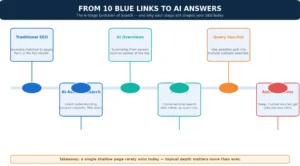
Search did not jump from ten blue links to AI answers overnight. It moved through stages, and each stage still affects how you work today.
Stage 1: Traditional SEO
Users typed keywords. Google matched pages to those keywords using relevance, links, and quality signals. Winning meant ranking in the top results.
Stage 2: AI-assisted search
Google used machine learning to understand intent better. Search began to understand meaning, not only exact words. Featured snippets and “People also ask” boxes grew out of this stage.
Stage 3: AI Overviews
Google began generating summaries from multiple sources. A single answer could draw on several pages, so ranking first no longer guaranteed being the only visible result.
Stage 4: AI Mode
AI Mode is a more conversational search experience. Google describes it as its most powerful AI search experience. People can ask longer questions, add follow-ups, and explore links to the web.
Stage 5: Query fan-out
Behind both AI Overviews and AI Mode, Google may use a technique called query fan-out. It splits a question into subtopics and runs several related searches at once.
Stage 6: Authority and source selection
Because the system gathers evidence from many searches, it must choose which sources to trust and cite. Sites with deep, accurate, well-organized coverage of a topic have a better chance of being selected.
This progression explains why a single, shallow page rarely wins today. It also explains why topical depth matters more than it used to.
How Mavrank can help: Stage 6 rewards brands that publish focused, expert content and earn credible mentions elsewhere. Our content creation service produces research-led articles built to demonstrate that depth.
How Query Fan-Out Changes Content Strategy
Query fan-out is the most important idea in this article, so it deserves a clear explanation.
Imagine someone searches: “how to fix a lawn full of weeds.” Google’s own guidance gives this kind of example. The system may also search for related questions, such as the best herbicides for lawns, ways to remove weeds without chemicals, and how to prevent weeds from returning. It then combines what it finds into one response.
Now apply that to your industry. A person asking “how to choose an SEO agency for a SaaS company” may trigger searches on pricing models, link building quality, reporting, and contract terms. Your single page on “choosing an SEO agency” competes with pages that cover each subtopic well.
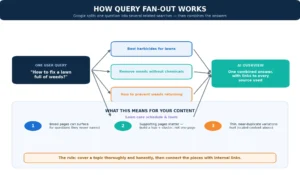
This has three practical consequences.
- Broad pages can surface for questions they never named. Google says fan-out helps it find a wider range of sources. A page that explains a subtopic clearly can appear even when it does not match the original query word for word.
- Supporting pages matter. A strong hub page backed by detailed supporting articles gives Google more material to retrieve.
- Thin variations hurt you. Google warns against creating content for every possible query variation, mainly to manipulate rankings or AI responses. That can violate its scaled content abuse policy.
The lesson is simple. Cover a topic thoroughly and honestly, then connect the pieces with logical internal links. Do not mass-produce near-duplicate pages.
If you run a SaaS business, our guide on SaaS SEO strategy for 2026 shows how to build that kind of connected topic cluster.
How Mavrank can help: Planning a cluster is easier with a clear map of hub pages, supporting articles, and link targets. Our team builds these plans as part of content and link building projects.
AI Overviews vs AI Mode vs Featured Snippets
These three features overlap, but they behave differently.
| Feature | What it does | Typical use |
| Featured snippet | Highlights one excerpt from a single page | A narrow, direct question |
| AI Overview | Generates a summary from several sources, with links | A question that benefits from a combined answer |
| AI Mode | Offers a conversational experience with follow-ups and deeper exploration | Complex, multi-step research |
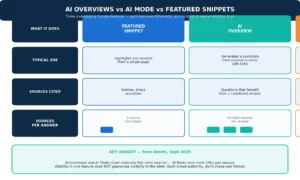
Google states that AI Mode and AI Overviews may use different models and techniques, so the responses and links they show can vary.
An Ahrefs study from September 2025 found that the two features share relatively few cited sources. AI Mode also tended to cite more URLs per answer than AI Overviews did. Treat that as a snapshot, because these systems keep changing. The takeaway still holds: visibility in one feature does not guarantee visibility in the other.
How Mavrank can help: Because citation patterns differ across features, broad authority helps more than chasing one format. Quality link building from relevant publications supports that wider authority.
What Google Says About Ranking in AI Features
Google’s Search Central documentation is the most reliable source here, and its message is more measured than much of the industry commentary.
- No special requirements exist. Google states there are no additional requirements to appear in AI Overviews or AI Mode, and no special optimizations are necessary.
- SEO best practices still apply. Your pages need to be crawlable, indexable, and eligible to appear in Search with a snippet.
- Performance data sits inside Search Console. Traffic from AI features is included in your overall search traffic reporting, not separated into its own report.
- Valuable, non-commodity content wins. Google’s guide for generative AI features stresses original, useful content made for people.
So the “Google AI SEO guide” is not a secret playbook. It is a reminder to do the fundamentals well and to stop chasing shortcuts.
If you want the primary sources, read Google’s official page on AI features and your website and its guide to optimizing your website for generative AI features on Google Search.
How Mavrank can help: Fundamentals still decide eligibility. Our SEO audit service checks crawlability, indexation, snippet eligibility, and content quality so nothing blocks your pages.
What Is SEO for AI Called? GEO, AEO, and Why Labels Matter
You will see several names for optimizing toward AI answers:
- GEO: Generative Engine Optimization
- AEO: Answer Engine Optimization
- LLMO: Large Language Model Optimization
- AI SEO: A general label
These terms are popular, and they describe real behavior across tools like Google, ChatGPT, and Perplexity. However, the claim that “GEO replaces SEO” is unsupported. Google says SEO best practices remain relevant for its AI features, and the retrieval systems behind AI answers still depend on indexed, high-quality web content.
A better way to think about it: GEO and AEO are extensions of good SEO. They place more weight on clear answers, strong entities, and trustworthy sources. They do not cancel keyword research, technical health, or link authority.
Use the labels if your team finds them helpful. Just avoid treating them as a separate religion.
How Mavrank can help: Whatever name you choose, the work is the same: clear content, credible sources, and strong authority. Our team combines all three under one strategy.
A Practical Framework to Earn Visibility in AI Overviews
No tactic guarantees inclusion. Still, you can improve your odds by working through these areas in order.
1. Make your pages eligible
Start with the basics. Confirm that:
- Important pages are indexable and not blocked by robots.txt or noindex tags.
- Google can render your content, including text inside tabs or scripts.
- Pages load fast and work well on mobile.
- Key information appears in visible text, not only in images or video.
Google does not require special AI schema. Structured data still helps search engines understand your page, so keep it accurate and matched to visible content.
2. Build real topical depth
Pick a core topic and cover it from several angles. Include definitions, comparisons, costs, mistakes, tools, and examples. Link these pages together so both users and crawlers can follow the path.
This approach fits fan-out well, because the system can find a relevant page for each subtopic.
3. Write modular, answer-first sections
AI systems extract passages. Help them by writing sections that stand on their own:
- Use a clear heading that mirrors a real question.
- Answer in the first one or two sentences.
- Follow with context, an example, or a short list.
- Keep paragraphs short and focused.
This also makes your page easier for humans to skim, which is the real goal.
4. Add original value
Commodity content is easy to replace. Add something an AI summary cannot copy cheaply:
- First-hand experience and case results
- Original data, surveys, or benchmarks
- Expert commentary with named authors
- Clear opinions backed by evidence
5. Strengthen authority beyond your site
Google still weighs how the wider web treats you. Relevant mentions, editorial links, and guest contributions on respected sites signal trust. Our guest blogging service places expert content on relevant publications, and our SaaS link building service focuses on software and tech brands.
6. Keep content fresh and accurate
Update statistics, screenshots, and product details. Outdated pages weaken trust and may lose citations to newer sources.
7. Use internal links with purpose
Link from broad pages to detailed ones with descriptive anchor text. Good internal links help Google understand how your pages relate, which supports the topical authority this guide keeps returning to.
How Mavrank can help: Most teams know this framework but lack time to execute all seven steps. We can handle research, writing, link building, and technical review together. Contact us to discuss a plan.
Are AI Overviews Accurate?
Often yes, but not always.
AI Overviews generate text from retrieved sources. That means mistakes can appear when sources conflict, when the question is unusual, or when the system misreads context. Google has publicly acknowledged odd and incorrect overviews in the past and said it made improvements. Even so, no summary should be treated as final on health, legal, or financial topics.
For site owners, this matters in two ways:
- Your accuracy builds your citation value. Pages with clear facts, dates, and named sources give the system better material.
- Your brand can be misdescribed. Check what AI answers say about your company, and correct the problem at the source by improving your own pages and your public profiles.
For readers, the safe habit is simple: open the cited links and verify important claims.
How Mavrank can help: Reliable source material starts with careful writing. Our editors fact-check, cite credible sources, and keep articles current, which supports long-term trust.
Ads in AI Overviews
Advertising has entered AI search too. Google says ads can be eligible to appear above, below, and in some markets within AI Overviews.
Here is what advertisers should know:
- Eligibility depends on your existing campaigns. Google documentation has pointed to text and shopping ads from existing Search, Shopping, and Performance Max campaigns. Newer AI-led campaign types also play a role.
- Availability varies by country. Google’s documentation has listed supported countries, including several beyond the United States. Check the current list for your market.
- Sensitive categories are restricted. Google has said it does not show ads in AI Overviews for topics such as adult content, alcohol, gambling, finance, healthcare, and politics.
- Reporting is limited. Ads inside AI Overviews are folded into broader prominence metrics rather than reported separately.
Advertising rules change often, so verify details in Google Ads Help before you spend budget.
Paid placement does not replace organic visibility. Organic content builds the trust that makes both organic citations and paid results work better.
How Mavrank can help: Strong organic authority lowers your reliance on paid clicks. If you want to compare approaches, our article on pay-per-performance SEO explains how performance-based models really work.
How to Hide or Turn Off AI Overviews
Many people search for “turn off AI Overviews” or “how to turn off AI Overviews Google.” Here is the honest answer: Google does not offer a setting that permanently turns them off. Several workarounds exist.
Option 1: Use the Web filter
After you search, select Web under the search box. Google says this view shows text-based links without features like AI Overviews. You must repeat it for each search.
Option 2: Use a custom search engine with udm=14
Many guides recommend adding a custom search engine in your browser with this URL:
https://www.google.com/search?q=%s&udm=14
Set it as your default. This loads the Web results view on every search. Be aware that Google does not document this parameter in its help pages, so it could change.
On desktop Chrome, you can find this under Settings, then Search engine, then Manage search engines. Firefox users can add a custom search engine through search settings, depending on the version. Mobile browsers vary, and Safari handles this differently.
Option 3: Install a browser extension
Searches for “hide Google AI Overviews extension” and “hide Google AI Overviews Firefox” lead to extensions that remove the AI block from the page. These are third-party tools. They can stop working when Google changes its page code, so review permissions before installing.
Option 4: Try a different search engine
If you prefer search without AI summaries, another search engine is the most reliable route.
What about website owners?
Website owners cannot opt out of AI features while staying fully visible in Search. Google’s snippet controls, such as nosnippet, data-nosnippet, and max-snippet, can limit how your content appears, but they also reduce your presence in regular results. For most businesses, hiding is the wrong strategy. Earning citations is the better one.
How Mavrank can help: Instead of fighting the feature, build content worth citing. Our team can show you how to turn AI-driven search into a source of qualified visitors.
Free AI Tools for SEO Optimization
You do not need an expensive stack to start. These free tools cover most of what matters:
- Google Search Console: See impressions, clicks, queries, and indexing issues. Since AI feature traffic counts inside Search Console totals, it remains your primary reporting source.
- Google Analytics: Track engagement and conversions from organic traffic.
- Google Trends: Spot rising topics and seasonal changes.
- PageSpeed Insights: Check performance and Core Web Vitals.
- Rich Results Test: Validate structured data.
- Bing Webmaster Tools: Monitor visibility in Bing, which also feeds other search experiences.
- Free tiers of AI assistants: Use them to brainstorm outlines, summarize research, and test how a topic gets explained. Always verify facts, and never publish unedited output at scale.
A tool cannot replace judgment. Use tools to speed up research, then rely on human expertise to decide what deserves to be published.
How Mavrank can help: If tool reports feel overwhelming, our experts can translate the data into a prioritized action list.
How to Measure Performance in the AI Era
Measurement is harder when features overlap, so combine several views.
- Track impressions and clicks in Search Console. Watch topic-level trends, not only single keywords.
- Monitor branded search growth. More people searching your name often signals rising awareness.
- Check conversions, not just traffic. Fewer clicks can still produce more leads if visitors arrive better informed.
- Review citations manually. Search your priority queries and note which pages appear in AI answers.
- Compare engagement. Look at time on page, scroll depth, and assisted conversions.
Remember that a drop in clicks does not always mean a drop in value. Some AI-driven visitors are further along in their decision and convert at higher rates. Test this with your own data instead of trusting generic claims.
A 90-Day Action Plan
1 to 30 Days: Fix the foundation
- Run a full technical and content audit.
- Identify pages that already earn impressions on question-based queries.
- Update outdated pages and fix indexing problems.
31 to 60 Days: Build depth
- Choose one core topic and map a hub page plus six to ten supporting articles.
- Rewrite key sections in an answer-first style.
- Add original data, examples, and named expert authors.
61 to 90 Days: Earn authority
- Publish guest articles on relevant industry sites.
- Pursue link insertions in related existing content.
- Review Search Console trends and refresh your cluster.
If outsourcing makes sense for your team, read our guide on how to outsource SEO the right way before choosing a partner.
Frequently Asked Questions
What are AI Overviews in Google Search?
AI Overviews are AI-generated summaries that appear above some search results. They combine information from several web sources into a short answer and include links to those sources, so people can explore further.
Do I need special optimization to appear in AI Overviews?
No. Google states that no additional requirements or special optimizations are needed. Your pages must be indexed and eligible to show a snippet, and they should offer helpful, original, people-first content. Strong fundamentals remain the best strategy.
Does GEO replace SEO?
No. GEO and AEO describe extra attention to answer quality and authority, but they build on SEO instead of replacing it. Google says SEO best practices remain relevant for AI Overviews and AI Mode.
Can I turn off AI Overviews in Google?
Not permanently. Google offers no official off switch. You can select the Web filter for individual searches, set a custom search engine using the udm=14 parameter, use a browser extension, or switch search engines.
Are AI Overviews always accurate?
No. They can contain errors, especially on unusual or fast-changing topics. Open the linked sources and verify important details, particularly for health, legal, or financial decisions.
Conclusion: The Game Has Changed, but the Rules Have Not Disappeared
AI Overviews transform how people see search results, but they do not erase SEO. Google still relies on crawlable pages, quality content, and trusted sources. What changes is the standard. Thin pages, copied summaries, and scattered topics lose ground, while deep coverage, original insight, and real authority gain it.
Treat AI Overviews as a signal to raise the quality of everything you publish. Fix your foundation, build topic clusters, and earn credible mentions across the web.
If you want a partner for that work, MavRank offers SEO audits, content creation, guest blogging, and link building built for this new search environment. Get in touch to start.